
In This Article
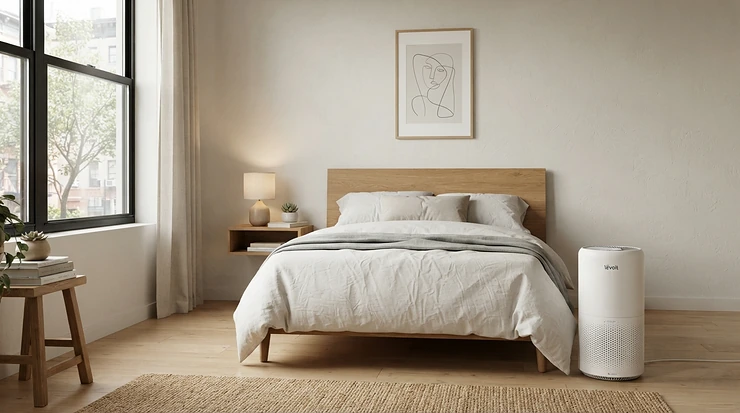
A HEPA air purifier for dust mite allergies in bedroom use is a fan-driven unit that pushes room air through a dense filter rated to capture 99.97% of particles at 0.3 microns. It doesn’t kill mites. It thins out the allergen-carrying debris floating around while you sleep.
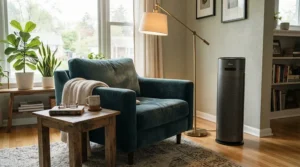
Here’s the part most roundups skip: that’s a supporting role, not a starring one. Dust mites live in your mattress, pillows, and carpet, and the fundamentals come first. Mayo Clinic’s home-remedy guidance calls for allergen-proof covers on mattresses and pillows, weekly hot washing at 130°F or higher, and indoor humidity under 50 percent. A purifier sits on top of that foundation. Skip the foundation, and no filter on earth will rescue your nights.
So why bother? Because every time you flop onto the bed, shake out a duvet, or even roll over, you launch microscopic debris into the air you’re about to breathe for eight hours. A well-chosen purifier beside the bed grabs a share of that cloud before your nose does. The trick is picking one that’s strong enough for your room, quiet enough that you’ll actually leave it running, and honest about its specs.
That’s what this guide delivers. I compared seven real models using published specs, independent test data, and aggregated owner reviews. That is research, not hands-on lab time, and I won’t pretend otherwise. Prices below are ranges as of October 2026 and shift constantly, so check current pricing before you buy.
HEPA Air Purifier for Dust Mite Allergies in Bedroom: Quick Comparison
Before the deep dives, here’s the whole field on one screen. Focus on the CADR column first. CADR (clean air delivery rate) tells you how many cubic feet of cleaned air per minute a unit delivers, and it’s the number that separates a real bedroom machine from a decorative one.
| Model | CADR (cfm) | Rated Room Size | Filter Type | Price Range | Best For |
|---|---|---|---|---|---|
| Coway Airmega Mighty AP-1512HH | 246 dust / 240 pollen / 233 smoke | ~361 sq ft | True HEPA + carbon | $170-$230 | All-round bedrooms |
| Levoit Vital 200S | ~245 overall | ~375-380 sq ft | True HEPA + carbon | $170-$200 | Quiet smart control |
| Blueair Blue Pure 311i Max | 250 (listed) | ~387 sq ft | HEPASilent + carbon | $185-$230 | Light sleepers |
| Winix 5500-2 | ~232-246 | ~360 sq ft | True HEPA + PlasmaWave | $120-$160 | Budget airflow |
| Levoit Core 300S | ~141 | ~219 sq ft | True HEPA + carbon | $100-$150 | Small bedrooms |
| Medify MA-15 | ~78 smoke (third-party reported) | ~120 sq ft by 4.8 ACH math | H13 HEPA + carbon | $100-$130 | Nurseries, tiny rooms |
| Austin Air HealthMate HM400 | No verified CADR found | Large (retailer claim) | Sealed medical-grade HEPA + carbon/zeolite | $600-$850 | Long-term sensitivity |
The Coway Airmega Mighty AP-1512HH, Levoit Vital 200S, Blueair Blue Pure 311i Max, and Winix 5500-2 cluster tightly on airflow, so your decision there comes down to noise, features, and availability. The Levoit Core 300S and Medify MA-15 trade power for price and only suit smaller rooms. The Austin Air HealthMate HM400 plays a different game entirely, with sealed construction and a multi-year filter at a premium price.
💬 Just one click — help others make better buying decisions too!😊
Top 7 HEPA Air Purifier Picks for Dust Mite Allergies in Bedroom: Expert Analysis
1. Coway Airmega Mighty AP-1512HH — best all-round bedroom workhorse
Think of the Coway Mighty as the reliable station wagon of air purifiers: unfashionable, roomy, and still on the road years after launch.
Listed CADR figures of 246 for dust, 240 for pollen, and 233 for smoke earn a rated room size of about 361 square feet. In plain English, that’s enough muscle to cycle a typical 150-to-250 square foot bedroom several times an hour, well past AHAM’s two-thirds rule. An optional ionizer is built in. One retail explainer notes it can produce trace ozone, so I’d leave it off for sensitive sleepers.
Based on the spec comparison, this suits anyone who wants proven airflow without an app. Auto mode adjusts fan speed to what the sensor detects, and eco mode idles the fan after 30 minutes of clean air. What the spec sheet won’t tell you: RTINGS reports it gets noisy at higher speeds, and notes the Coway Mighty2 has replaced it, so stock of the original may thin out.
Aggregated sentiment: retailer pages showed roughly a 4.7-star average across more than a thousand ratings at the time of research. Owners repeatedly cite quiet operation and easy controls.
Pros:
- ✅ Strong dust CADR for the price
- ✅ Simple controls, no app required
- ✅ Auto and eco modes save energy
Cons:
- ❌ Noisy at higher fan speeds
- ❌ Succeeded by a newer model
Price range: roughly $170-$230. Verdict: excellent value if bedroom airflow is your priority; confirm which version is in stock.
2. Levoit Vital 200S — smart, quiet, and unusually fast
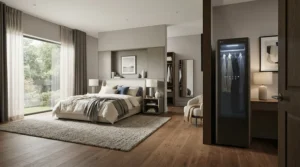
The Levoit Vital 200S is the one that tends to win arguments between “I want power” and “I want sleep.”
According to HouseFresh, its AHAM Verifide certificate lists an overall CADR of 245 cfm, good for rooms up to roughly 375 square feet. Independent measurements put the sleep-mode noise around 41 dBA and the top speed near 62 dBA. Those numbers mean you can run it on low overnight and still get meaningful air turnover in a typical bedroom, then kick it up for a few minutes after changing the sheets. HouseFresh’s testing found it cleared a particle-removal test in about 23 minutes, which they called one of the fastest units under $200.
Here’s what to weigh: it uses a pre-filter, True HEPA, and an activated carbon layer, and its replacement filters cost more but last somewhat longer, per AirPurifierFirst. One reviewer noted it doesn’t display live PM2.5 readings. I couldn’t verify a large owner-review sample for this model, so treat this section’s sentiment as independent-tester-driven rather than crowd-driven.
Pros:
- ✅ Verified CADR matches real-world testing
- ✅ Quiet sleep mode with app control
- ✅ Washable pre-filter and long-lasting filter
Cons:
- ❌ No live PM2.5 number on display
- ❌ Pricier replacement filters
Price range: roughly $170-$200. Verdict: arguably the best balance here for a smart, quiet bedroom unit.
3. Blueair Blue Pure 311i Max — whisper-quiet HEPASilent for light sleepers
If you wake at the click of a thermostat, the Blueair Blue Pure 311i Max deserves your attention.
Its HEPASilent technology combines electrostatic and mechanical filtration, which is how Blueair moves lots of air at low noise. Retailer listings cite a CADR of 250 for smoke, dust, and pollen, and a 387 square foot room at about 12.5 minutes per full air exchange. Blueair’s own pages note CADR and room-size values were updated to meet newer DOE standards, so expect small differences between packaging and websites. Noise is listed at 23-50 dB, and a washable fabric pre-filter handles the larger debris.
One honest caveat: HEPASilent is Blueair’s own term. The company claims 99.97% capture down to 0.1 microns, but if the strict “true HEPA” label matters to you, read the listing closely.
Aggregated sentiment: Best Buy showed about a 4.8-star average from roughly 260 reviews at the time of research. Customers frequently mention quiet low-speed operation and accurate air-quality readings.
Pros:
- ✅ Very quiet at low speeds
- ✅ Wi-Fi app with filter tracking
- ✅ Washable fabric pre-filter
Cons:
- ❌ HEPASilent isn’t classic true HEPA
- ❌ Filters follow a set replacement schedule
Price range: roughly $185-$230. Verdict: worth the premium for noise-sensitive sleepers.
4. Winix 5500-2 — most airflow per dollar
The Winix 5500-2 is the scrappy overachiever: not pretty, but astonishingly capable for the money.
AHAM-verified figures in the 232-246 range across smoke, pollen, and dust support a 360 square foot rating. HouseFresh calculated roughly 74 cents per CADR cfm, which is remarkable. Filtration runs through a washable pre-filter, washable carbon, True HEPA, and PlasmaWave, which can be switched off. For dust mite duty, I’d turn PlasmaWave off and let the HEPA do the work.
The catch is noise: one reviewer measured about 40.6 dBA on its lowest setting and 66.4 dBA at maximum, so keep it on low overnight. Also check availability, since HouseFresh reported this model and its sibling were being discontinued in the U.S. and Canada as inventory runs out.
Aggregated sentiment: Looria’s review analysis graded it an A across about 100 reviews. Reviewers praised effectiveness and quiet operation, with quality-control complaints about the remote.
Pros:
- ✅ Excellent CADR for the price
- ✅ Washable carbon pre-filter saves money
- ✅ Dust, pollen, and smoke all handled
Cons:
- ❌ Loud at maximum speed
- ❌ Possibly being phased out
Price range: roughly $120-$160. Verdict: unbeatable value if you can still find it.
5. Levoit Core 300S — compact smart option for small bedrooms
The Levoit Core 300S is the “just get something good” pick for small rooms.
Energy Star data lists its AHAM-tested CADR at about 141 cfm. Levoit rates it for 219 square feet, while independent math suggests closer to 200 for a full 4.8 air changes per hour. In practice, it’s well matched to a 100-150 square foot bedroom and starts to struggle beyond that. Measured noise runs around 41.4 dBA on low and 65.2 dBA at maximum, and it adds app and voice-assistant control.
What most buyers overlook: it’s about half the airflow of the bigger models above. In a small kid’s room that’s fine. In a master suite, it isn’t.
Aggregated sentiment: an aggregator showed a roughly 4.6-4.7 average across many thousands of Amazon ratings, in the high-4-star range, as of August 2026. Reviewers typically praise its compact size and smart features.
Pros:
- ✅ Great fit for rooms under about 150 sq ft
- ✅ App, Alexa, and Google Home support
- ✅ Compact footprint
Cons:
- ❌ About half the airflow of larger units
- ❌ Loud at maximum speed
Price range: roughly $100-$150. Verdict: the smart small-room bargain.
6. Medify MA-15 — H13 filtration on a small-room budget
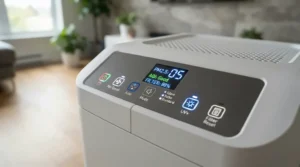
The Medify MA-15 leads with its filter grade, and that’s both its pitch and its trap.
It uses an H13 True HEPA filter with pre-filter and carbon layers, and carries CARB, ETL, and Energy Star certifications according to Best Buy’s FAQ. Here’s the wrinkle: listings advertise “CADR 150,” but Medify quotes that in cubic meters per hour, which is roughly 88 cfm. One third-party site reports an AHAM smoke CADR of 78 cfm, and by AHAM’s 4.8 ACH convention that suggests around 120 square feet, far below the 293-330 square feet some listings claim.
Filters are listed at 3-4 months or 2,500 hours at about $35-$39 each, which adds up. A lifetime warranty softens the blow.
Aggregated sentiment is thin: Best Buy showed 4.9 stars from only 9 reviews, while a Walmart listing showed 4.4 from about 69 reviews. Not a large sample.
Pros:
- ✅ H13 HEPA at a low entry price
- ✅ Lifetime warranty listed
- ✅ Compact for nurseries and dorms
Cons:
- ❌ Low airflow for the claimed coverage
- ❌ Frequent filter replacements
Price range: roughly $100-$130. Verdict: a tiny-room specialist, not a whole-bedroom solution.
7. Austin Air HealthMate HM400 — sealed construction and a five-year filter
The Austin Air HealthMate HM400 is the heavyweight: expensive, bulky, and built like it’s meant to outlast your mattress.
It uses a four-stage setup: two pre-filters, roughly 15 pounds of carbon/zeolite, and about 60 square feet of medical-grade HEPA media, inside a sealed housing with gaskets at each filter end. Retailers cite airflow above 250 cubic feet per minute and filter life of up to five years. I couldn’t confirm an AHAM Verifide CADR, so treat the airflow claim cautiously.
Based on the design, this fits people whose sensitivities go well beyond dust mites. The tradeoffs are real: a frontdeskreview summary of Wirecutter’s coverage flagged its high price, bulk, noise, and energy use.
Aggregated sentiment: Looria’s analysis highlights “great for allergies and asthma” alongside “loud but effective,” plus occasional complaints of a new-carbon smell and shipping damage. Sylvane showed 4.7 stars across 120 reviews.
Pros:
- ✅ Sealed, gasketed filter housing
- ✅ Filters rated for up to five years
- ✅ Strong carbon/zeolite capacity
Cons:
- ❌ Very high upfront cost
- ❌ Loud and bulky
Price range: roughly $600-$850. Verdict: justified only if sealed construction and long filter life matter to you.
How to Set Up Your Bedroom Purifier: Placement, Settings, and a 30-Day Routine
A great purifier badly placed is a mediocre purifier. Put it near the bed, since that’s where mite debris gets stirred up, but don’t aim it at your face. Leave clear space around the intake and keep it out from behind curtains or furniture. Most manuals specify clearances, so check yours.
Now the timing trick. Mite-allergen particles are relatively heavy and settle quickly, according to a medical reference chapter on air cleaners, which is exactly why a purifier can’t be your only defense. So run it on a higher setting while you change sheets, fluff pillows, or vacuum, then drop to a quiet speed overnight. Keep the door closed so the unit works on one room’s volume.
Your 30-day routine:
- Week 1: Install the purifier, add a cheap hygrometer, and aim for under 50 percent humidity.
- Week 2: Wash or vacuum the pre-filter if yours is washable, as the Winix 5500-2 and Blueair Blue Pure 311i Max allow.
- Week 3: Hot-wash bedding at 130°F or higher, and confirm covers are zipped.
- Week 4: Track sleep and symptoms honestly, then check your filter-life indicator.
Two common first-month mistakes: judging results in three days, and buying “compatible” filters of unknown quality. AHAM warns non-genuine filters can undermine performance, which matters for allergy sufferers.
Real-World Scenarios: Matching a Purifier to Your Bedroom
Specs mean little until they meet a floor plan. Here are four profiles, with the math behind each.
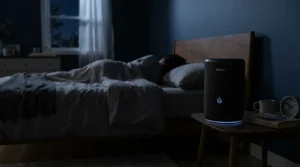
The light sleeper in a 140 sq ft apartment bedroom ($200 budget, nightly use). The Blueair Blue Pure 311i Max and Levoit Vital 200S both fit. At a CADR of roughly 250, a 140 square foot room with 8-foot ceilings sees over 13 air changes an hour at full speed, so you can run either on its quietest setting and still get plenty of turnover.
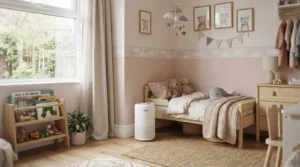
The parent of a 110 sq ft kid’s room (tight budget, nightly use). The Levoit Core 300S delivers close to 10 air changes an hour here at its tested 141 cfm. The Medify MA-15 is cheaper but manages roughly 5 changes by the third-party figures.
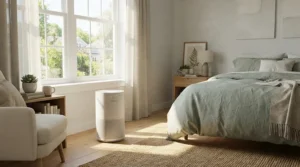
The owner of a 340 sq ft primary bedroom (about $150 budget). The Winix 5500-2 gives about five air changes per hour, which is solid. The Coway Airmega Mighty AP-1512HH lands in the same territory with a simpler interface.
The long-haul sensitive sleeper (flexible budget, 24/7 use). The Austin Air HealthMate HM400 makes sense when sealed construction and multi-year filters matter more than upfront cost. Just remember I couldn’t verify its CADR.
How to Choose a HEPA Air Purifier for Dust Mite Allergies in Bedroom
Choose a unit with a verified dust CADR sized to your room, a genuine HEPA-class filter, and a sleep mode quiet enough to leave on all night. Here’s the process:
- Measure your room. Multiply length by width and note the ceiling height; taller ceilings need more airflow.
- Apply AHAM’s two-thirds rule. Dust CADR should be at least two-thirds of your floor area for 8-foot ceilings.
- Demand verified numbers. Look for the AHAM Verifide seal, or search AHAM’s directory of certified models.
- Confirm the filter class. True HEPA or H13 matters more than gimmicks; ignore ionizers and ozone claims.
- Judge the sleep mode. An unbearably loud unit gets switched off, and an off purifier cleans nothing.
- Price three years of filters. Cheap machines with expensive, frequent filters cost more than they look.
- Check availability and warranty. Discontinued models complicate filter supply.
True HEPA Air Purifier for Dust Mite Control: What the Label Really Promises
A true HEPA air purifier for dust mite control must meet the U.S. standard of capturing 99.97% of particles at 0.3 microns. That benchmark is the hardest size to catch, so larger mite debris is generally trapped more easily. Dust mites themselves are around 250 microns, far larger than any HEPA pore.
So the filter isn’t the weak link. The reservoir is. Mites live in bedding and carpet and keep shedding, so a purifier can only clear what becomes airborne. A 1991 study in the journal Allergy, summarized on PubMed, tested a HEPA air-cleaning device in mite-allergic patients without further avoidance measures. Its authors concluded HEPA air cleaners appear insufficient as substitutes for standard avoidance measures. That’s old research, and models are better now, but the logic holds: treat the purifier as an add-on to covers, hot washing, and humidity control.
Also, carbon filters don’t trap particles. They address gases and odors, so carbon is a bonus here, not the engine.
CADR Rating: The Number That Decides Bedroom Performance
CADR rating is the single most useful figure on any purifier box. AHAM’s Verifide program publishes separate scores for tobacco smoke, pollen, and dust, and for dust mites the dust score is the one to watch. A higher number means the unit delivers filtered air faster.
Two conversions make the number practical. AHAM’s suggested room size assumes 4.8 air changes per hour, which equals CADR multiplied by about 1.55. That’s why the Levoit Core 300S (141 cfm) lands near 219 square feet and the Winix 5500-2 (232 cfm) near 360. The room size is based on the smallest of the three CADR scores, so the dust figure may be higher than the headline coverage implies.
Watch the units, too. Some brands quote cubic meters per hour, where 1 cfm is about 1.7 m³/h. That’s how the Medify MA-15‘s “150” shrinks to roughly 88 cfm. Always compare in cfm, and prefer AHAM-verified figures over manufacturer-only claims.
H13 Filtration: Useful Upgrade or Label Inflation?
H13 filtration is a European classification (EN 1822) requiring a filter to capture at least 99.95% of its hardest-to-catch particles, while the U.S. true HEPA standard is 99.97% at 0.3 microns. Those are close cousins, not rivals. For particles as large as dust mite debris, the practical gap is essentially nil.
What H13 filtration does not do is add airflow. Take the Medify MA-15: it advertises H13 media, yet its verified airflow is modest. Meanwhile the Coway Airmega Mighty AP-1512HH and Winix 5500-2 use standard true HEPA and move far more air. For allergy relief, a good filter plus plenty of airflow beats a premium filter in a weak machine.
Where H13 helps is marketing clarity: it signals a defined grade rather than a vague “HEPA-type” phrase. Treat it as a nice-to-have, never the deciding factor.
Particle Capture Efficiency: What 99.97% Does and Doesn’t Tell You
Particle capture efficiency describes how much of a given particle size a filter traps in a single pass. It’s an excellent filter metric and a poor whole-machine metric. A 99.97% filter that moves little air still cleans slowly, which is why CADR, essentially efficiency multiplied by airflow, is the better yardstick.
Two details matter. First, efficiency varies by size, and the toughest range sits around 0.1 to 0.3 microns. Claims like Blueair Blue Pure 311i Max and Medify MA-15 making 99.97% or 99.9% down to 0.1 microns are manufacturer claims, so verify what you can. Second, leaks matter. Air that slips around a filter never gets filtered, which is where sealed design enters the picture.
Sealed HEPA Air Purifier for Dust Sensitivity: Why Gaskets Matter
A sealed HEPA air purifier for dust sensitivity forces all intake air through the filter media, with gaskets closing the gaps. The Austin Air HealthMate HM400 is the clearest example here, with thick gaskets at each filter end and no air mixing between dirty and clean sides.
Does it matter? In theory, yes: a leaky housing lowers real-world efficiency. In practice, how much leakage a given budget unit has is rarely published, so I can’t tell you the Levoit Core 300S or Winix 5500-2 leak meaningfully. What I can say is that sealing earns its keep for people with broader sensitivities, and for anyone who wants certainty over savings.
The honest tradeoff: sealed doesn’t mean powerful. Pair sealed construction with enough airflow for your room, and remember the cost, around $600-$850 versus $100-$230 for most alternatives.
HEPA Air Purifier vs Traditional Dust Mite Controls
Here’s how a purifier compares with the classic defenses:
| Method | What It Targets | Main Strength | Main Limit | Best For |
|---|---|---|---|---|
| HEPA air purifier | Airborne particles | Cleans air continuously | Doesn’t reach mattress reservoir | Supplementing other controls |
| Allergen-proof encasements | Mattress, pillows, box spring | Blocks mite colonization | Doesn’t clean room air | Foundation of control |
| Hot-wash bedding (130°F+) | Sheets, blankets | Kills mites, removes allergen | Needs weekly effort | Weekly routine |
| Dehumidifier (under 50% RH) | Mite survival | Attacks mites at the source | Climate-dependent | Humid homes |
| HEPA vacuum | Floor/rug debris | Convenient | Manchester researchers found no advantage over standard models | Not a standalone fix |
Read the table as a stack, not a menu. Encasements and humidity control fight the source; a purifier mops up what escapes. One University of Manchester study found HEPA vacuums were no better than standard vacuums at reducing allergen exposure, and personal exposure actually rose during cleaning, so don’t assume “HEPA” on a label equals results.
Long-Term Cost & Maintenance
Sticker price is only half the story. Filters, electricity, and noise-driven behavior (whether you actually run it) determine real value.
| Model | Price Range | Filter Cost Signal | Value Verdict | Best For |
|---|---|---|---|---|
| Coway Airmega Mighty AP-1512HH | $170-$230 | Replacements listed around $35-$57 | Strong | Medium bedrooms |
| Levoit Vital 200S | $170-$200 | Pricier but longer-lasting | Strong | Quiet smart control |
| Blueair Blue Pure 311i Max | $185-$230 | Set schedule; washable fabric pre-filter | Good if quiet matters | Light sleepers |
| Winix 5500-2 | $120-$160 | Washable carbon; HEPA from ~$46 | Excellent if available | Budget airflow |
| Levoit Core 300S | $100-$150 | Not verified in research | Good in small rooms | Small bedrooms |
| Medify MA-15 | $100-$130 | ~$35-$39 per 3-4 months | Weak per dollar | Tiny rooms |
| Austin Air HealthMate HM400 | $600-$850 | ~$290-$340, up to five years | Pays off over years | Sensitive users |
The Medify MA-15 looks cheap until you run it nonstop: at 2,500 hours per filter, that’s roughly $105-$140 a year in replacements. The Austin Air HealthMate HM400 works out to roughly $58-$68 a year in filters if it truly lasts five years, but only after a hefty upfront bill. For most households, the Winix 5500-2, Coway Airmega Mighty AP-1512HH, or Levoit Vital 200S offer the best total cost of ownership.
Common Mistakes When Buying a HEPA Air Purifier for Dust Mite Allergies in Bedroom
Trusting coverage claims at face value. As the Medify MA-15 shows, advertised square footage can far exceed what verified CADR supports. Do the 1.55 math yourself.
Buying on filter grade alone. H13 filtration in a weak fan is a sports car with a lawnmower engine.
Enabling gadgets you don’t need. Ionizers and similar features add little for mite debris, and the ionizer on the Coway Airmega Mighty AP-1512HH may produce trace ozone, so keep it off.
Ignoring noise. The Winix 5500-2 hits roughly 66 dBA at maximum, so plan to live on low.
Skipping genuine filters. AHAM warns non-genuine filters can compromise performance, and that’s a health risk for allergy sufferers.
Expecting a purifier to replace covers. It won’t, as the 1991 research suggests.
Forgetting ceiling height. Rated room sizes assume 8-foot ceilings.
FAQ
❓ Where should I place a purifier in my bedroom for dust mite allergies?
❓ Should I run my bedroom air purifier all night?
❓ How often should I replace the filter?
❓ What CADR do I need for a 150 square foot bedroom?
❓ Is a sealed HEPA air purifier worth the extra money?
Conclusion
Let’s land the plane. For most bedrooms, the shortlist comes down to the Levoit Vital 200S for quiet smart control, the Coway Airmega Mighty AP-1512HH for proven simplicity, the Blueair Blue Pure 311i Max for light sleepers, and the Winix 5500-2 for budget airflow if you can still find one. The Levoit Core 300S handles small rooms, the Medify MA-15 fits tiny nurseries, and the Austin Air HealthMate HM400 earns its price only if sealed construction and multi-year filters are worth it to you.
Keep your expectations honest, too. Researchers studying air cleaners and house dust mite allergens note the ability of these devices to remove mite allergens is still controversial, and that’s exactly why covers, hot washing, and humidity control come first. A purifier is the finishing touch, not the foundation.
Match the dust CADR to your room, give it a spot beside the bed, and let it hum quietly while you sleep better than you have in months.
✨ Ready to Upgrade Your Bedroom Air?
🔍 Take your sleep to the next level with these carefully compared picks. Click any highlighted product name to check current pricing and availability. A purifier that fits your room could help you wake up breathing easier!
Recommended for You
- [Add your blog post link 1]
- [Add your blog post link 2]
- [Add your blog post link 3]
Disclaimer: This article contains affiliate links. As an Amazon Associate, I earn from qualifying purchases. If you purchase products through these links, we may earn a small commission at no additional cost to you.
✨ Found this helpful? Share it with your friends! 💬🤗
