
In This Article
Your cat is adorable. Her litter box, around hour thirty, is not. And somewhere in between, a fine cloud of skin flakes is drifting through your living room, riding the air currents like tiny paper boats.
Here’s the problem in one sentence: dander is a particle problem, and litter box smell is a gas problem, so you need two different kinds of filtration working together. An air purifier for pet dander and litter box odor pairs a true HEPA filter, which traps airborne allergen particles, with a thick activated carbon bed, which adsorbs the ammonia and sulfur gases behind the stink. Most machines nail the first half and fumble the second.
The EPA’s consumer guide to air cleaners makes the same split. Particles need a filter with a suitable CADR, and gases need an activated carbon filter that contains a large amount of material. “Large amount” is where the marketing gets slippery. A flat carbon sheet and a multi-pound carbon bed both get called “activated carbon filters” on the box.
This guide sorts the real contenders from the box-copy heroes. Below are seven real purifiers, from budget to premium, with plain-English analysis of what their specs mean in a home with fur and a litter tray. We’ll also cover dander particle size, why carbon weight matters, and how to place the unit in a small apartment. We close with a decision framework for multi-pet homes.
Quick Comparison Table: 7 Purifiers for Dander and Litter Box Odor
| Product | Odor Media | Published Airflow / Coverage | Approx. Price Range | Best For |
|---|---|---|---|---|
| Austin Air HealthMate Plus | ~15 lb carbon and potassium-iodide bed | Built for steady, whole-room cycling | $600–$700 range | Multi-box homes, severe odor |
| Winix 5510 | ~0.5 lb pelletized carbon | ~253 CFM smoke CADR, ~392 sq ft | $120–$180 range | Budget odor control |
| Levoit Vital 200S-P | Pelletized carbon, pet-friendly inlet | ~245 CFM class, ~380 sq ft | $160–$230 range | Pet hair plus one or two animals |
| Levoit Core 400S | Activated carbon stage | ~260 CFM, ~400 sq ft | $190–$250 range | Apartment all-rounder |
| Levoit Core 600S | Carbon pellets | ~390–410 CFM, 550+ sq ft | $260–$320 range | Open-plan living areas |
| Coway Airmega 400 | Carbon pellets | ~330–370 CFM, ~575 sq ft | $400–$650 range | Quiet, premium big rooms |
| Medify MA-40 | Granular carbon pellets | ~239 CFM, ~373 sq ft | Around $250 | Odor control per dollar |
Figures come from published manufacturer and independent comparison data at the time of research, and CADR numbers vary slightly by source. Prices fluctuate, so check current price before you buy.
Read the table as a trade-off map. The Austin Air HealthMate Plus buys the most odor-fighting mass but costs the most and brings none of the smart features. The Winix 5510 and Medify MA-40 sit at the other end, with modest carbon and a friendly price. The Levoit Core 600S and Coway Airmega 400 win when your room is large and you want fast particle turnover.
💬 Just one click — help others make better buying decisions too!😊
Top 7 Air Purifiers for Pet Dander and Litter Box Odor: Expert Analysis
Every pick below comes from real product specs and aggregated reviewer findings, not hands-on ownership. Where reviews disagree, I say so.
1. Austin Air HealthMate Plus — 15-pound carbon bed for brutal odor
The standout is the carbon bed, which is huge. One 2026 pet-purifier roundup describes about fifteen pounds of activated carbon and potassium-iodide media, plus medical-grade HEPA media. Compare that with the thin carbon mats in most mainstream units, and the gas-handling capacity is in a different league. A deeper bed means more surface for ammonia to stick to before it saturates.
Based on the spec comparison, this is the machine for a home with two or three boxes, a senior cat with accidents, or a stubborn smell that has soaked into furniture. HouseFresh named it the best they’d tested for VOCs and singled out multi-cat homes as the audience. The trade-offs are weight, a utilitarian look, no app, and slower perceived “whoosh” than modern Wi-Fi machines.
Reviewers consistently describe it as a “set it by the box and forget it” appliance rather than a gadget.
Pros:
- ✅ Deepest carbon bed in this roundup
- ✅ Medical-grade HEPA handles airborne dander
- ✅ Long filter life reported by reviewers
Cons:
- ❌ Heavy, bulky, and plain-looking
- ❌ No smart features or auto mode
Expect a price in the $600–$700 range. That’s steep upfront, but if odor is your main complaint, it’s the strongest value on this list.
2. Winix 5510 — budget odor control with pelletized carbon
Winix pairs a washable pre-filter, a True HEPA filter, and a pelletized carbon layer in one machine. Published testing puts its smoke CADR at about 253 CFM, which on the EPA’s sizing chart comfortably covers a 390-square-foot room. In practice, that suits a bedroom or small living room with a litter box in the corner.
The carbon stage weighs roughly half a pound by one buying guide’s account, so don’t expect it to scrub a three-box household. What it does well is tackle everyday litter smell and light pet odor while the HEPA layer traps dander. Reviewers note the washable pre-filter catches hair before it clogs the main filter, which saves money over time. One comparison found it louder than the Levoit Vital at maximum speed, around 65 dBA, so you’ll probably run it on auto.
It also includes PlasmaWave tech, so check whether you want that enabled in a home with sensitive pets or people.
Pros:
- ✅ Strong CADR for the price
- ✅ Washable pre-filter catches hair
- ✅ Pelletized carbon, not a flat sheet
Cons:
- ❌ Carbon amount is modest
- ❌ Loud at top speed
Expect the $120–$180 range. As a value pick for one cat and one box, it’s hard to beat.
3. Levoit Vital 200S-P — pet-friendly inlet built for fur
Levoit built this model specifically around pet households. One tester explains that its U-shaped air inlet is designed to catch fur and dander. That’s paired with a washable pre-filter, a pelletized carbon stage, and a Pet Mode that ramps filtration when air quality drops.
On paper, Levoit rates its coverage at roughly 380 square feet for strict particle clearing, though some retailer listings advertise far larger numbers at slow air-change rates. Use the smaller figure when sizing. Reviewers frequently recommend it for homes with one pet, and one hands-on comparison found it slightly ahead of the Winix 5510 in particle tests. The caveat is carbon quantity: it’s good for routine smell, not for a multi-box situation.
The smart app and air quality sensor mean you can watch the PM2.5 reading drop after you scoop the box, which is oddly satisfying.
Pros:
- ✅ Pet-focused inlet and Pet Mode
- ✅ Smart app with air quality readout
- ✅ Quieter at max speed than the Winix 5510
Cons:
- ❌ Carbon bed is not heavy duty
- ❌ Pre-filter needs regular cleaning in shedding season
The listing sits around the $160–$230 range, and reviewers rate it highly on major retailer pages.
4. Levoit Core 400S — compact all-rounder for apartments
This tower earns its spot because it’s the one that works in small spaces and still behaves politely. A published comparison lists it at about 260 CFM CADR and roughly 400 square feet of recommended coverage, which fits a typical apartment living room.
A tester with cats reported less loose fur around the home and noticed that smells didn’t linger as long when the unit ran near the litter box. HouseFresh also found it performs better than a rival at quiet speeds, which matters if your cat sleeps in the same room. The limit is carbon mass: it’s a regular activated carbon stage rather than a heavy bed, so one or two cats is the sweet spot.
Think of it as the machine you buy when the box lives in a hallway nook and you want to forget the purifier exists.
Pros:
- ✅ Good airflow for its footprint
- ✅ Quiet at low and mid speeds
- ✅ Smart controls and auto mode
Cons:
- ❌ Not built for multi-box odor
- ❌ Replacement filters add up over time
Expect a $190–$250 range. For a single-cat apartment, it’s the pick I’d start with.
5. Levoit Core 600S — fast air turnover for open-plan spaces
Bigger room, bigger fan. Published CADR figures vary between about 390 and 410 CFM depending on the source, while Rtings measured its PM1.0 clean air delivery at roughly 363 CFM. All of these say the same thing: it moves a lot of air, enough to cover over 550 square feet at maximum speed.
That matters when the litter box lives in a great room, because the odor has to be captured before it spreads. It uses carbon pellets, a step above a flat sheet, and has a washable pre-filter for pet hair. One pet-purifier review crowned it best overall for households with cats and dogs. Rtings ranked the Coway Airmega 400 slightly ahead overall, while calling the Levoit a compelling lower-priced alternative.
Because the carbon is still a modest bed, treat this as a “dander plus everyday odor” machine, not a deep-odor specialist.
Pros:
- ✅ Very high airflow for the price
- ✅ Carbon pellets, not a thin sheet
- ✅ Smart features and a washable pre-filter
Cons:
- ❌ Louder at top speed
- ❌ Carbon bed is moderate for big odor loads
Look in the $260–$320 range. It’s best when you need whole-zone coverage, not a single-corner fix.
6. Coway Airmega 400 — whisper-quiet premium for big rooms
Coway’s tower is the quietest high-airflow option here. Rtings measured around 31.6 dBA at the lowest speed and about 60 dBA at the highest, a touch lower than the Levoit Core 600S in both cases. Its measured PM1.0 CADR comes in around 368 CFM, and Rtings recommends it for rooms up to about 575 square feet at max.
The filters can last longer than average, with one source noting roughly a year versus six months for some rivals. That reduces ongoing cost. It also uses carbon pellets and washable pre-filters. Rtings concluded it was a better air purifier overall than the Levoit, although the Levoit adds app control and costs far less. If you want something that disappears into the background, it’s the one.
The caveat is that the standard model lacks smart connectivity, and it doesn’t carry a deep carbon bed for heavy litter loads.
Pros:
- ✅ Quiet operation at every speed
- ✅ Longer filter life lowers upkeep
- ✅ Washable pre-filter handles hair
Cons:
- ❌ Highest price among the mainstream picks
- ❌ No app on the standard model
Prices swing widely, roughly $400–$650, so watch for deals. It’s worth it if noise is your biggest dealbreaker.
7. Medify MA-40 — granular carbon pellets without a premium tag
The MA-40 is the dark horse. A 2026 pet-purifier ranking says its granular carbon pellets give more odor-absorbing surface than other models around $300, which is why it earns a spot for cat owners. Published specs show roughly 239 CFM smoke CADR and about 373 square feet of coverage, with True HEPA H13 filtration.
For a bedroom or den with a litter box, that’s a solid match. The same reviewer suggested it for litter boxes, multiple cats, or dogs with skin conditions that smell, while calling the Levoit Core 600S their all-rounder. The compromise is a plainer interface and fewer smart features than Levoit.
If you want strong carbon performance without paying Austin Air prices, this is a smart middle road.
Pros:
- ✅ Granular carbon pellets for better odor capture
- ✅ H13 True HEPA for dander
- ✅ Straightforward, no-fuss operation
Cons:
- ❌ Fewer smart features
- ❌ Coverage is moderate for open spaces
Expect to pay around $250. For odor per dollar, it’s hard to argue with.
Looking at the field, the Austin Air HealthMate Plus wins on pure odor capacity, but the Medify MA-40 and Winix 5510 deliver far better price-to-performance for one or two cats. If you need to cover a large open area, the Levoit Core 600S gives you more air movement for less money than the Coway Airmega 400, though the Coway wins on silence. Apartment dwellers with a single box should look first at the Levoit Core 400S.
How to Choose an Air Purifier for Pet Dander and Litter Box Odor
Picking right comes down to six checks. Work through them in order.
- Measure your room. Multiply length by width in square feet. The EPA’s sizing guide suggests roughly a 260 CFM CADR for a 400-square-foot room, scaling up from there. Round up if you have high ceilings.
- Insist on true HEPA. Dander is a particle, and true HEPA filters are rated to capture 99.97% of particles at 0.3 microns. Anything less is a gamble.
- Weigh the carbon. Look for pounds or grams of activated carbon, not the phrase “carbon filter.” Pellets or granules beat a thin sheet because the air has to pass through real depth.
- Match carbon to box count. One box and one cat can live with a modest bed. Multiple boxes call for a heavy bed or a pair of machines.
- Check noise at your daily speed. A purifier you switch off because it’s loud filters nothing. Compare decibel readings at low and medium speeds.
- Budget for filters. Replacement carbon filters wear out faster near a litter box, so factor in a yearly cost.
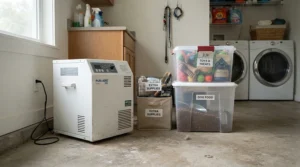
Dander Particle Size: What the HEPA Filter Actually Has to Catch
Dander is not a single thing. A British study of homes with cats, published in Thorax, measured the airborne cat allergen Fel d 1 and found that about 23% of it rode on small particles under roughly 4.7 microns, with the bulk on bigger ones. The takeaway is that the smaller fraction stays airborne for a long time and hangs around even after the cat leaves the room.
Different guides quote different ranges for dander particle size, from around 1 to 10 microns for most flakes. That range sits comfortably above the 0.3-micron “hardest to catch” size that HEPA ratings are tested against, so a true HEPA filter should handle it. It also explains why a purifier’s smoke CADR is a sensible proxy: smoke particles are the smaller end of the spectrum.
One more reality check. Heavier particles, such as clumps of loose fur, fall to the floor before they reach the filter. That’s why vacuuming still matters and why a washable pre-filter earns its keep. What the purifier does best is catch the invisible, lighter fraction that you can’t sweep up.
Activated Carbon Bed: Why Weight Matters More Than Marketing
Walk down any purifier aisle and nearly every box says “activated carbon.” The honest question is how much. The HouseFresh litter-box roundup shows the spread clearly. Some machines carry a few hundred grams, one large tower lists 400 grams of pelleted carbon, and the Austin Air HealthMate carries a 15-pound gas filter.
The EPA notes that activated carbon can work well when a large amount of material is used, and that thicker is better. That’s the physics in one line. Gases pass through the bed and stick to its internal surface. Once the surface is full, the bed stops working, and the smell starts leaking back.
Here’s what that means for you. A thin carbon sheet may take the edge off one box for a few weeks. A pelletized bed lasts longer and works harder. A multi-pound bed handles continuous loads from multiple cats for far longer. If you can’t find the carbon weight on the product page, assume it’s modest and plan to replace filters sooner.
Ammonia Odor Removal: What Carbon Can (and Can’t) Do
Cat urine smells because bacteria break urea down into ammonia, and the sulfur compounds from waste add their own sharp edge. These are gases, and a HEPA filter, which is designed for particles, lets them sail straight through.
Activated carbon works through adsorption: ammonia molecules cling to its porous surface instead of passing through. Buying guides note that coconut-shell carbon has pores sized well for small molecules like ammonia, and some products add zeolite to target ammonia specifically. The Austin Air bed pairs carbon with potassium-iodide media for exactly this broader gas load.
For ammonia odor removal, three things matter: carbon mass, airflow through the bed, and dwell time. A strong fan with a thin bed pushes gas through too fast. A thick bed with weak airflow barely samples the room. The best results come from a decent CADR and a deep bed, which is why the tower designs above perform better than flat-panel units.
Finally, don’t skip the source. Scoop daily, wash the box regularly, and use a quality litter. A purifier handles what’s left in the air, not what’s festering in the tray.
Air Purifier for Cat Litter Smell in Apartment: Placement and Picks
Apartments make everything harder. Boxes live in closets, bathrooms, or hallway nooks, rooms are small, and air barely moves. The good news is that small rooms need less CADR.
For an air purifier for cat litter smell in apartment living, treat the box as the problem and put the purifier within a few feet of it, ideally with airflow unobstructed. The EPA advises keeping units away from curtains and anything that blocks the intake. A tower like the Levoit Core 400S or the Winix 5510 fits the footprint and runs quietly at night.
Consider a scenario. You’re a renter in a 600-square-foot one-bedroom with one cat and a box in the bathroom. Closing the door traps the smell, but every time you open it, you get a gust. Put the Levoit Core 400S in the hall pointed toward the bathroom door and run it on auto. The sensor ramps it up when you scoop, then settles. For a harder case, such as a studio where the box shares space with your bed, the Medify MA-40‘s granular carbon is a stronger choice.
✨ Don’t Miss These Exclusive Deals!
🔍 Take your home’s air to the next level with these carefully selected purifiers. Click on any highlighted product name to check current pricing and availability. These picks will help you create a fresher, calmer home your whole family, furry members included, will love!
Pet Hair Resistant Air Purifier for Multi-Pet Homes
Hair is the silent killer of purifiers. It clogs intakes, coats pre-filters, and starves the fan. A pet hair resistant air purifier for multi-pet homes needs a washable pre-filter, an intake that doesn’t suck fur straight into the main filter, and enough airflow to keep working with a coating of fluff.
The Levoit Vital 200S-P was designed for exactly this, with its pet-focused inlet and Pet Mode. The Winix 5510, Levoit Core 600S, and Coway Airmega 400 all use washable pre-filters that catch hair first. In a dog-plus-cats household, plan on rinsing that pre-filter every two to four weeks in shedding season. Skipping that step is the number one reason purifiers underperform.
Multi-pet also means more dander and often more than one box. If you have three or more animals, the honest advice is to run two machines: a high-CADR unit like the Levoit Core 600S for the main living area and a carbon-heavy unit like the Austin Air HealthMate Plus or Medify MA-40 parked near the boxes. It costs more upfront, but each machine does the job it’s best at.
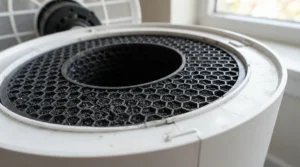
Practical Usage Guide: Setup, Placement, and First-30-Day Tips
A purifier is only as good as its setup. Here’s the routine that gets the most from any of these seven.
Placement. Put it within a few feet of the litter box, with at least a foot of clearance on all sides. Don’t tuck it behind a couch.
Settings. Run it on auto, or on a steady medium speed, around the clock. Higher speeds and longer runtimes increase the amount of air filtered, per the EPA, so don’t switch it off when the room smells fine.
Pre-filter care. Vacuum or rinse the washable pre-filter every few weeks. In shedding season, check it weekly.
Carbon filter schedule. Near a litter box, plan to replace carbon more often than the manufacturer’s generic timeline, because ammonia loads it fast.
First-month mistakes to avoid:
- Placing it across the room from the box
- Running it only when guests come over
- Forgetting to scoop, which overwhelms any carbon bed
- Using scented sprays that add particles and fragrance for the carbon to fight
Give it two or three weeks of consistent running before judging it. Dander and odor levels in the room fall gradually, not instantly.
Real-World Scenarios: Matching Picks to Three Households
The studio renter. One cat, one box, 450 square feet, and a tight budget. The Winix 5510 covers the room’s size and handles routine smell, and the washable pre-filter keeps maintenance cheap. Place it near the box and run on auto.
The family with two cats and a dog. A 900-square-foot open living space, two boxes, and a shedding dog. Pair a Levoit Core 600S in the main area with a Medify MA-40 near the boxes. You get airflow where the people are and carbon depth where the odor is.
The multi-cat house with a laundry-room litter station. Three cats, three boxes, one closed utility room. The Austin Air HealthMate Plus parked in that room provides the deep carbon bed the problem demands, while a smaller HEPA unit like the Levoit Vital 200S-P handles dander in the living room.
Each profile follows the same logic: put heavy carbon where gases originate and high airflow where people breathe.
Problem and Solution Guide: Fixing the Five Most Common Complaints
“The room still smells.” Usually the carbon bed is saturated or undersized. Replace the filter, move the purifier closer to the box, or step up to a heavier carbon unit.
“My allergies haven’t improved.” Check that you have true HEPA and that the CADR matches the room size. The EPA notes studies show improvements in some symptoms but not all, so manage expectations and keep vacuuming and washing bedding.
“It’s too loud.” Choose a quieter unit like the Coway Airmega 400 or run a larger machine at a lower speed rather than a small one flat out.
“Hair keeps clogging it.” Clean the washable pre-filter more often, and consider a pet-focused inlet like the Levoit Vital 200S-P.
“Filters cost too much.” Look for longer-life filters like the Coway Airmega 400‘s and avoid running a thin carbon filter into the ground. Replacing it on time protects the HEPA layer too.
Air Purifiers vs Litter Box Odor Absorbers and Ozone Gadgets
Not every odor product is built the same, and some shortcuts can backfire.
| Option | Captures Dander | Handles Ammonia | Main Drawback | Best For |
|---|---|---|---|---|
| HEPA plus carbon purifier (like the Levoit Core 400S) | Yes | Yes, depending on carbon mass | Filters need replacing | Dander and odor together |
| Standalone carbon absorbers or bags | No | Moderate, near the box only | Small capacity, no airflow | Boosting a box, not a room |
| Ozone generators | No | Claims only | Lung irritant | Nobody with pets at home |
| Scented sprays and plug-ins | No | No, masks only | Add fragrance to the air | Nothing worth recommending |
The table makes the case: only a HEPA-plus-carbon purifier addresses both problems. Carbon absorbers can complement a purifier but don’t move air. Ozone is a bigger issue. The EPA advises avoiding air cleaners that intentionally produce ozone, calling it a lung irritant, and notes that no federal agency has approved ozone generators sold as air cleaners for use in occupied spaces. In a small apartment with a cat breathing at floor level, that’s a hard pass.
Long-Term Cost and Maintenance: What You’ll Really Spend
Sticker price tells you half the story. Filter replacement and electricity fill in the rest.
| Tier | Upfront | Filter Rhythm | Ongoing Feel | Best For |
|---|---|---|---|---|
| Budget (Winix 5510, Medify MA-40) | Low | Carbon changes more often near boxes | Low to moderate | One or two cats |
| Mid (Levoit Vital 200S-P, Core 400S, Core 600S) | Moderate | Roughly twice yearly in many cases | Moderate | Apartments and families |
| Premium (Coway Airmega 400) | High | Longer cycles reported | Lower | Quiet, big rooms |
| Heavy carbon (Austin Air HealthMate Plus) | Highest | Very long cycles reported | Lowest per year | Severe odor |
Looking at it over three or four years, the premium Austin Air HealthMate Plus can close the gap with cheaper machines because you buy fewer filters. The Coway Airmega 400 works the same trick on a smaller scale. But if your odor load is light, the Winix 5510 and Levoit Core 400S keep total cost of ownership lower. Match the machine to the problem, because overbuying carbon for a single-cat home wastes money.
FAQ: Air Purifier for Pet Dander and Litter Box Odor
❓ Can an air purifier really remove litter box smell?
❓ How much carbon do I need for multiple cats?
❓ Will an air purifier pick up pet hair from the floor?
❓ Should I run my purifier 24/7?
❓ Are ozone-producing purifiers safe around cats?
Conclusion: Pick the Machine That Matches Your Problem
Let’s land this. Dander wants a true HEPA filter with a CADR that fits the room. Litter box smell wants carbon, and the more of it, the better. Any air purifier for pet dander and litter box odor worth buying delivers both, and the seven here do it at different budgets and scales.
If one cat and one box is your reality, the Levoit Core 400S, Winix 5510, or Medify MA-40 will serve you well. Hair-heavy homes should lean toward the Levoit Vital 200S-P. Big open spaces suit the Levoit Core 600S or the whisper-quiet Coway Airmega 400. And if the smell is truly punishing, the Austin Air HealthMate Plus is the heavyweight that no thin carbon sheet can match.
Whatever you choose, place it near the box, run it constantly, and keep scooping. The machine does its best work when you do yours.
Recommended for You
- Quiet Air Purifier for Light Sleepers and Nurseries: 7 Best 2026
- Air Purifier for Wildfire Smoke in Large Open Living Room: Top 7 2026
- HEPA Air Purifier for Dust Mite Allergies in Bedroom: 7 Best (2026)
Disclaimer: This article contains affiliate links. As an Amazon Associate, I earn from qualifying purchases. If you purchase products through these links, we may earn a small commission at no additional cost to you.
✨ Found this helpful? Share it with your friends! 💬🤗
