In This Article
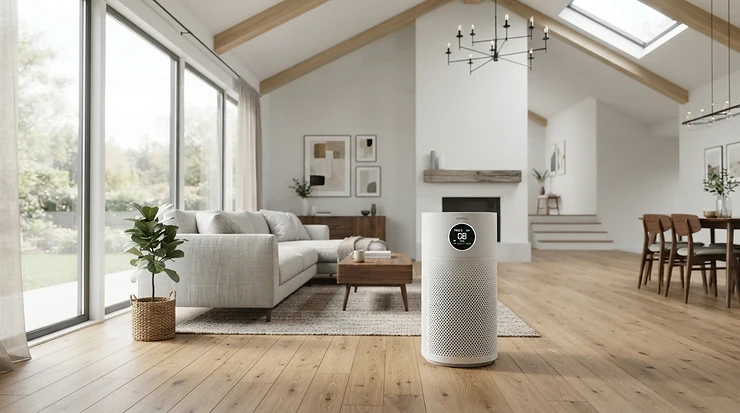
Wildfire smoke doesn’t care about your floor plan. It slips through window gaps, rides in on the HVAC system, and then settles into the biggest, most connected chunk of air in your house. That chunk is usually your great room. Choosing an air purifier for wildfire smoke in large open living room layouts is a different job than buying a bedroom unit. There are no doors to close and no walls to hold the clean air in. Kitchen, dining area and sofa all share one giant airshed.
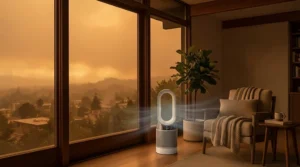
The U.S. EPA’s clean room guidance for wildfire smoke says to filter the air with a portable cleaner that is the right size for the room and run it on the highest fan setting you can tolerate. “Right size” is the sticky phrase. Most purifiers advertise generous square footage, but those numbers are often calculated at gentle air-change rates that smoke season laughs at.
This guide does the math for you. I’m not claiming to have tested these machines in my living room. What follows is analysis built on published specs, independent lab-style tests, and the patterns that show up across real owner and reviewer feedback. You’ll get seven real products, the sizing rules, an honest look at carbon, and a plan for the house you actually have.
What Is an Air Purifier for Wildfire Smoke in Large Open Living Room?
An air purifier for wildfire smoke in large open living room spaces is a portable HEPA-and-carbon air cleaner whose smoke CADR is high enough to move and scrub the entire connected area, not just one corner. It captures fine particles, including PM2.5, and adsorbs some smoke gases and odors.
Quick Comparison Table: 7 Wildfire-Smoke Purifiers at a Glance
| Product | Smoke CADR (CFM) | Carbon Load | Built-In Sensor | Price Range | Best For |
|---|---|---|---|---|---|
| Levoit Core 600S-P | ~391 | 160 g standard, 360 g Smoke Remover | Laser PM2.5 | $250–$300 | Best value main unit |
| Blueair Blue Pure 211i Max | ~410 | Carbon layer; SmokeBlock adds 2x | Air quality indicator | $250–$350 | Quiet large-room coverage |
| Coway Airmega 400 | 328 | Carbon in both filter sets | Particle sensor + AQI light | $450–$650 | Balanced dual-intake workhorse |
| Coway Airmega ProX | 568 | Carbon-HEPA Max2 filters | PM1/PM2.5/PM10 | $850–$1,000 | One machine for 600+ sq ft |
| Winix 5510 | 253 | ~226 g pellets | Air quality sensor | around $200 | Budget second unit |
| Austin Air HealthMate Plus | ~156 (estimated) | Up to 15 lb | None | $850–$900 | Heavy gas and odor loads |
| IQAir HealthPro Plus | ~260–300 (cited) | ~5 lb carbon-zeolite | None | $900–$1,000 | Sealed premium filtration |
Look at the table sideways and you’ll notice the products fall into two camps. The Coway Airmega ProX, Blueair Blue Pure 211i Max and Levoit Core 600S-P are air movers, built to cycle a big volume fast. Austin Air HealthMate Plus and IQAir HealthPro Plus are chemical filters with a fan attached, built to hold a lot of carbon. An open living room usually needs both talents, which is why pairing is a recurring theme below.
Budget buyers should note that the Winix 5510 can’t carry a big room alone, but at its price it makes an excellent partner unit. If you want a single-box answer, the Coway Airmega ProX is the only one here whose smoke CADR clears a 600 square foot space by itself. Prices drift constantly, so check current prices before you commit.
💬 Just one click — help others make better buying decisions too!😊
Top 7 Air Purifiers for Wildfire Smoke in Large Open Living Rooms: Expert Analysis
Every pick below is judged on smoke CADR, carbon, sensing, noise and long-term cost. Price ranges were gathered at the time of research and may vary.
1. Levoit Core 600S-P — best smoke CADR per dollar
The pitch here is arithmetic. A smoke CADR of roughly 391 CFM, in the $250–$300 range, is hard to beat. Some retailer listings quote slightly higher numbers, so treat 391 as the conservative AHAM-cited figure.
Under the EPA two-thirds rule, 391 CFM supports about 585 square feet. The stricter AHAM wildfire rule, which matches CADR to floor area, gives you roughly 390. The filter stack is pre-filter, HEPA and pelleted carbon, with a laser PM2.5 sensor that shows live readings on a color ring. The standard filter carries 160 g of carbon (about 0.35 lb). The optional Smoke Remover filter raises that to 360 g, around 0.8 lb. Levoit lists the unit as CARB and ENERGY STAR certified.
If you want the best first purchase for a big room, this is it, and the Smoke Remover swap is how I’d configure it for fire season. Reviewers consistently praise its speed and app control, and HouseFresh’s incense-smoke test cleared a 728 cubic foot room in under 15 minutes. One tester noted that Levoit quietly dropped “H13” language from current marketing, so shop on CADR, not buzzwords.
Pros:
- ✅ Strongest smoke CADR for the money
- ✅ Real-time laser PM2.5 readout
- ✅ Smoke Remover filter more than doubles carbon
Cons:
- ❌ Stock carbon load is modest for heavy smoke
- ❌ Smoke Remover filter is an extra purchase
The $250–$300 range makes it the value verdict winner of this roundup.
2. Blueair Blue Pure 211i Max — quiet, powerful large-room workhorse
The standout trait is the noise-to-output ratio. Blueair’s HEPASilent design is built to move a lot of air without sounding like a leaf blower, with a published 23–53 dB range and a 46 W power draw. Retail listings cite about 410 CFM of CADR (one roundup lists 435, so verify before you buy) and a recommended room size of 635 square feet at 4.8 air changes per hour.
That 635 figure uses the stricter air-change standard, so it’s more honest than many “covers 3,000 sq ft” claims you’ll see. The unit weighs about 16 lb and connects to an app. On paper, 410 CFM supports around 615 square feet under the EPA rule. Its weak spot is carbon. The stock carbon layer handles light odors, but heavy smoke is better served by Blueair’s SmokeBlock filter, which carries about twice the carbon.
Blueair’s own site shows a 4.6-star average across more than 2,000 reviews, and Consumer Reports testing, as cited by Blueair, rated it strongly for smoke. Buyers often mention quiet operation and the noticeable difference in air quality.
Pros:
- ✅ Very high CADR for its price
- ✅ Quiet across its fan range
- ✅ Lightweight and easy to reposition
Cons:
- ❌ Stock carbon is thin for smoke season
- ❌ SmokeBlock upgrade adds cost
At roughly $250–$350, this is a top-tier value for living rooms where noise matters.
3. Coway Airmega 400 — dual-intake all-rounder
This one’s trick is geometry. Two intakes feed two full filter sets, each with a washable pre-filter, HEPA layer and carbon layer. Its smoke CADR is 328, and Coway’s headline “1,560 sq ft” claim assumes only two air changes per hour. A fairer read puts it near 490 square feet under the EPA rule, and RTINGS measured a recommended room size around 575 square feet for particles.
RTINGS also measured a PM1 CADR of about 368 CFM and gave it solid marks, though it ranked the Blueair Blue Signature Large slightly higher. The unit is ENERGY STAR certified and has an air quality sensor with auto mode and an AQI light. The base model has no app, so don’t confuse it with the Wi-Fi-equipped 400S. For people who want to set it and forget it, that’s a feature rather than a bug.
Reviewers frequently comment on its efficiency and how unobtrusive the airflow feels, though some owners wish its smoke CADR were higher for the price.
Pros:
- ✅ Two filter sets for balanced loading
- ✅ ENERGY STAR efficiency
- ✅ Simple auto mode with AQI light
Cons:
- ❌ Lower smoke CADR than cheaper rivals
- ❌ No app on the base model
Expect a $450–$650 range depending on promotions. It’s a good value only when sales bring it toward the low end.
4. Coway Airmega ProX — the one-machine answer for 600+ square feet
Where the others are partners, this one is a solo act. Its smoke CADR is 568 CFM, which under the EPA rule supports around 850 square feet and under the AHAM wildfire rule about 570. HouseFresh measured a top-speed PM1 CADR of 462 CFM and cleared its 728 cubic foot test room in 13 minutes. Even more useful for multi-day smoke events, its PM1 CADR at sub-45 dBA noise levels was about 299 CFM. That is far higher than most competitors manage at a livable volume.
It uses a PM1, PM2.5 and PM10 laser sensor, runs 23–46 dB, and has hidden wheels. You’ll need them because it weighs roughly 51 lb. Estimated power cost is only about $17 a year, per Tom’s Guide. The trade-offs are cost and filters. Tom’s Guide notes replacement filters can cost around three times what competitors charge, and the unit lacks Wi-Fi.
Consumer Reports names it the standout for extra-large rooms. Reviewers praise the performance-to-noise ratio and complain about price and heft.
Pros:
- ✅ Highest smoke CADR in this lineup
- ✅ Strong performance at quiet speeds
- ✅ Very low energy use
Cons:
- ❌ Heavy and expensive
- ❌ Pricey replacement filters, no Wi-Fi
At roughly $850–$1,000, it’s worth it only when your room truly exceeds 600 square feet.
5. Winix 5510 — budget carbon-pellet sidekick
This is the smart second unit. At about $200, it brings a washable pre-filter, a True HEPA layer and pelleted carbon. Winix confirmed to HouseFresh that the carbon load is about 226 g, around half a pound. That’s modest next to the heavyweights but meaningful beside thin carbon sheets.
AHAM verifies a 253 CFM smoke CADR for 392 square feet. HouseFresh measured a top-speed PM1 CADR of 248 CFM and about 125 CFM at sub-45 dBA noise. At 23.5 dB on its lowest setting, it nearly disappears in a bedroom. An auto mode follows the built-in sensor, and a Winix app adds schedules and filter tracking. Optional PlasmaWave ionization can be switched off.
By the EPA rule, 253 CFM supports roughly 380 square feet, so in a big open space treat it as reinforcement. Reviewers like the compact footprint and the price, and their main complaint is that it can’t do the job of a larger machine.
Pros:
- ✅ Pelleted carbon at an entry price
- ✅ Washable pre-filter saves money
- ✅ Very quiet at low speeds
Cons:
- ❌ Can’t carry a 600 sq ft room alone
- ❌ Modest carbon weight for heavy smoke
For roughly $200, it’s an easy yes as a partner machine.
6. Austin Air HealthMate Plus — heaviest carbon on the market
If other purifiers carry carbon like a light jacket, this one wears a suit of armor. The filter packs medical-grade HEPA (about 60 sq ft) plus up to 15 lb of carbon and mineral media, impregnated with potassium iodide to target compounds such as formaldehyde, benzene and acrolein. The steel-bodied unit is 14.5 × 14.5 × 23 inches and weighs 47 lb. Austin says the filter lasts about five years under normal residential use, with a five-year pro-rated warranty.
Particle speed is the catch. HouseFresh estimated roughly 156 CFM of CADR for the standard HealthMate and needed 52 minutes to clear its test room, versus 28 for the IQAir. The Plus uses the same chassis, so expect similar airflow. That means it’s a gas-phase specialist, not an open-plan workhorse. Pair it with a high-CADR unit and let it handle smell and VOCs.
Reviewers praise the sheer carbon mass and long filter life. They criticize weight and slow particle clearing. Replacement filters run around $400–$450, which works out to about $80–$90 per year at normal use.
Pros:
- ✅ Up to 15 lb of carbon media
- ✅ Filter built for about five years
- ✅ Sturdy all-metal body
Cons:
- ❌ Slow particle clearing for big spaces
- ❌ No sensor, very heavy
At about $850–$900, buy it when smoke smell and VOCs are your main problem.
7. IQAir HealthPro Plus — sealed premium filtration
This is the Swiss-built elder statesman. It pairs a HyperHEPA filter with roughly 5 lb of carbon and zeolite. HouseFresh’s test cleared its 728 cubic foot room in about 28 minutes. That’s the fastest of the two heavy-carbon units and a strong showing for a gas-focused design. Cited CADR figures vary between roughly 260 and 300 CFM, and coverage is typically described as around 400 square feet.
The warranty is 10 years, and the design is sealed so air doesn’t bypass the filter. There is no app and no built-in sensor, which makes it feel like lab equipment. In an open living room I’d use it as a premium anchor in the zone where people sit, supported by an air-mover like the Levoit Core 600S-P.
Reviewers consistently praise its odor-handling quality and build. They note that replacement filter sets run well above mainstream brands and that it’s neither the cheapest nor the quietest option.
Pros:
- ✅ HyperHEPA plus about 5 lb of carbon
- ✅ Sealed design with 10-year warranty
- ✅ Faster particle clearing than the Austin
Cons:
- ❌ Expensive to buy and maintain
- ❌ No sensor or smart features
At $900–$1,000, it earns its price only if gases and odors dominate your smoke experience.
✨ Don’t Miss These Exclusive Deals!
🔍 Take your clean-air plan to the next level with these carefully selected products. Click any highlighted product name to check current pricing and availability. A well-matched purifier setup turns your open living room into a genuinely breathable space your family can rely on during smoke season!
Practical Usage Guide: Setting Up Your Open Living Room for Smoke Season
Buying the machine is half the job. Placement and routine do the rest, and Amazon’s listing won’t tell you any of this.
Step 1: Define your smoke zone. In an open plan, choose the area where you spend the most time, usually the sofa-and-TV zone, and treat that as the target. Measure the connected floor area in feet, because that number drives your sizing.
Step 2: Close what you can. Shut windows and exterior doors, and set your HVAC to recirculate. If your system accepts a MERV 13 filter, use it, since EPA guidance recommends that for smoke events.
Step 3: Place machines with breathing room. Keep intakes and outlets from being jammed against walls or sofas, and spread two units across the space rather than stacking them side by side.
Step 4: Run high when smoke is bad. The EPA says to run continuously on the highest setting you can tolerate. Once outdoor air improves, drop to auto or a lower speed.
Step 5: Maintain the washable parts. Vacuum or rinse pre-filters regularly. During smoke weeks they clog quickly, and the EPA advises replacing filters more often than the manufacturer schedule.
Step 6: Replace carbon at the first smoky smell. When odor returns, your carbon is spent.
Common mistakes in the first 30 days: relying on auto mode while smoke is thick, forgetting to reset filter timers, and buying only one machine for a room that needs two.
Real-World Scenarios: Which Purifier Fits Which Home
Here are three profiles, each matched to a setup with the math shown.
The loft renter (700 sq ft, 9-foot ceilings, tight budget). The EPA rule suggests about 467 CFM, and ceilings above 8 feet push that higher. A Levoit Core 600S-P (about 391 CFM) plus a Winix 5510 (253 CFM) gives roughly 640 CFM combined. That clears the target for around $450–$550 total. Swap in the Smoke Remover filter before fire season.
The family great room (1,000 sq ft, asthmatic teen, flexible budget). The EPA rule points to about 667 CFM. A Coway Airmega ProX (568 CFM) plus a Winix 5510 (253 CFM) gets you to roughly 820 CFM. For smoky-smelling summers, an Austin Air HealthMate Plus can handle gases while the others handle particles.
The work-from-home open studio (450 sq ft, quiet matters). Target about 300 CFM. A single Blueair Blue Pure 211i Max with the SmokeBlock filter clears it with room to spare, and its low-speed noise suits video calls.
Combined CADR figures are nominal and add up imperfectly in real rooms, so build in a margin.
How to Choose an Air Purifier for Wildfire Smoke in Large Open Living Room Spaces
Follow these seven steps in order.
- Measure the connected floor area. Multiply length by width for every space that shares air with the seating zone.
- Adjust for ceiling height. Anything above 8 feet holds more air, so size up.
- Compute your CADR target. The EPA guidance, echoed by ENERGY STAR’s wildfire air cleaner advice, is a smoke CADR of at least two-thirds of the room’s square footage. AHAM suggests matching CADR to the area during heavy smoke.
- Check smoke CADR, not coverage claims. Compare the AHAM-verified smoke number, not a vendor’s “covers up to” figure.
- Choose carbon deliberately. Decide whether you need light odor control or serious gas capacity.
- Confirm no ozone. The EPA recommends CARB-certified cleaners that limit ozone.
- Check the noise at the speed you’ll actually use. A machine you turn off is no help.
Air Purifier for Wildfire Smoke in Open Floor Plan: Sizing, Zoning and Placement
Here’s the truth about an air purifier for wildfire smoke in open floor plan homes: the layout makes the sizing math feel slippery. Air flows freely, so your machine is really cleaning a bubble of air that gradually mixes with the rest of the house.
Run through the numbers for a 600 square foot space. The EPA two-thirds rule says 400 CFM. The AHAM wildfire rule says 600. One analysis found that only a small fraction of ENERGY STAR-certified purifiers reach 400 CFM at all. That’s why the Coway Airmega ProX (568 CFM) stands out. For an 800 square foot great room, the EPA target is about 533 CFM and the AHAM target is 800.
Two good tactics apply to any air purifier for wildfire smoke in open floor plan layouts. First, zone it: close doors to hallways and bedrooms so you’re cleaning a smaller, cleaner area. Second, split the load: two mid-sized units placed at opposite ends of the room beat one unit in a corner, because they shorten the distance smoke has to travel to reach a filter.
An air purifier for wildfire smoke in open floor plan homes should also run before smoke peaks. Start it when forecasts turn bad, not once you smell the haze.
Smoke Removing Air Purifier With Deep Carbon Filter: Why Particles Aren’t the Whole Story
HEPA stops particles. Smoke is also a gas cocktail, and that’s where carbon comes in. A smoke removing air purifier with deep carbon filter adsorbs some of those gases and the smoky smell that lingers on curtains and couches.
Think of the difference as a coat of paint versus a bucket. Thin carbon sheets give the air a quick, shallow brush of adsorbent. A deep pelleted bed gives gases time and surface area to stick. That’s why carbon filter weight matters so much. A smoke removing air purifier with deep carbon filter holds more adsorbent, lasts longer before saturating, and handles heavier odor loads.
| Product | Carbon Filter Weight | Notes |
|---|---|---|
| Levoit Core 600S-P | 160 g (~0.35 lb) standard; 360 g (~0.8 lb) Smoke Remover | Swap-in upgrade |
| Winix 5510 | ~226 g (~0.5 lb) | Pelleted carbon, confirmed by Winix to HouseFresh |
| Blueair Blue Pure 211i Max | Not published; SmokeBlock has about 2x stock | Layer-style carbon |
| IQAir HealthPro Plus | ~5 lb | Carbon-zeolite blend |
| Austin Air HealthMate Plus | Up to 15 lb | Highest in this roundup |
| Coway Airmega 400 / Coway Airmega ProX | Not published | Carbon layers inside HEPA filters |
The table shows an enormous spread. The Austin Air HealthMate Plus carries roughly 40 times the carbon of the Levoit Core 600S-P‘s standard filter. But carbon weight isn’t everything. Airflow, contact time and media quality also matter, which is why the Austin Air HealthMate Plus is slow on particles. If you want a smoke removing air purifier with deep carbon filter capacity and speed, pair a heavy-carbon unit with a high-CADR machine.
One honest caveat: official wildfire guidance focuses on particles, and the evidence that carbon improves health outcomes is thinner than the evidence for smell and VOC reduction.
PM2.5 Removal: What the Spec Sheet Won’t Tell You
PM2.5 removal is the number that matters most for health, since fine smoke particles travel deep into the lungs. HEPA filters catch 99.97% of particles at 0.3 microns, so the filter itself is rarely the weak link. Airflow is.
Different tests tell different stories. The Winix 5510 posted a PM1 CADR of 248 CFM at top speed against an AHAM figure of 253, which is a close match. The Coway Airmega ProX measured 462 CFM PM1 against a 568 CFM AHAM smoke figure. The Coway Airmega 400 measured about 368 CFM PM1 at RTINGS against a 328 CFM AHAM smoke rating. These gaps come from methodology, so don’t treat them as contradictions.
What matters more for multi-day smoke is PM2.5 removal at a speed you can tolerate. At sub-45 dBA, HouseFresh logged about 299 CFM for the Coway Airmega ProX and about 125 CFM for the Winix 5510, while RTINGS measured about 117 CFM for the Coway Airmega 400. Different labs, so compare cautiously, but the pattern is clear. High-CADR machines keep delivering when you turn them down.
AQI Sensor: Handy Dashboard or Marketing Gimmick?
An AQI sensor sounds like a lifesaver, and sometimes it is. But AQI is a scale, and most purifier sensors measure particle concentrations and convert them. Check your outdoor reading on AirNow and treat the machine’s display as a trend line, not gospel.
The Levoit Core 600S-P uses a laser sensor with a live PM2.5 readout. The Coway Airmega ProX reads PM1, PM2.5 and PM10. The Blueair Blue Pure 211i Max and Coway Airmega 400 offer indicator-style feedback. The Austin Air HealthMate Plus and IQAir HealthPro Plus have none. Some older Winix models sensed only odors, not dust, so confirm what your sensor actually detects.
Two cautions apply. An AQI sensor tracks particles, not gases, so your display can read clean while the room still smells smoky. And auto mode tends to ramp down once the readings improve, which isn’t what you want in a smoke event. During smoke, override auto and run high.
Benefits vs Traditional Alternatives: Purifier, HVAC Filter or DIY Fan?
| Option | PM2.5 Removal | Gas/Odor Control | Open-Plan Fit | Best For |
|---|---|---|---|---|
| Portable HEPA + carbon purifier | Strong | Some to strong | Good with correct CADR | Coway Airmega ProX, Levoit Core 600S-P |
| HVAC with MERV 13+ filter | Good when the fan runs | None | Whole-house, but only while running | Homes with compatible systems |
| DIY box fan + MERV 13 filter | Limited (about 111 CFM measured by EPA for one filter) | None | Poor for big rooms | Emergency stopgap |
The EPA says DIY cleaners shouldn’t replace commercial portable units permanently. At roughly 111 CFM, a single DIY setup supports only about 110 square feet under the AHAM rule. In an open plan, that’s a rounding error.
A MERV 13 HVAC filter is worth using alongside a purifier. It cleans the whole house, but it can’t match a dedicated machine for speed in your seating area. The best setup combines both, with a Blueair Blue Pure 211i Max or similar in the living zone and the HVAC fan running as often as you can.
Common Mistakes When Buying an Air Purifier for Smoke
- Trusting “covers up to” claims. Coway’s 1,560 sq ft figure uses two air changes per hour, while Blueair cites 4.8. Compare smoke CADR instead.
- Ignoring ceiling height. A vaulted great room holds far more air than the footprint suggests.
- Buying one machine for a room that needs two. If your math says 800 CFM, one 400 CFM unit is a hopeful gesture.
- Skipping carbon. A HEPA-only unit leaves the smoky smell behind.
- Choosing ionizers or ozone makers. Look for CARB certification instead.
- Never replacing filters. Smoke loads filters faster, and spent carbon stops adsorbing.
Long-Term Cost and Maintenance: What These Purifiers Really Cost to Own
Sticker price is the shallow end. The Coway Airmega ProX costs about $17 a year to power but carries pricey filters, with Max2 filters on roughly a one-year cycle. The Winix 5510‘s filters are lighter on the wallet and its washable pre-filter extends their life. The Levoit Core 600S-P is cheap to run, though buying the Smoke Remover filter raises your replacement cost.
The Austin Air HealthMate Plus flips the math. A filter around $400–$450 that lasts roughly five years in normal conditions works out to about $80–$90 annually. During heavy smoke, plan to replace sooner, since the EPA advises swapping filters more often in smoke events. Budget roughly double during bad seasons.
The IQAir HealthPro Plus has a long warranty, but its replacement filter sets run well above mainstream brands. Weigh that against the benefit of its sealed design and heavier carbon.

FAQ: Wildfire Smoke Purifiers for Large Open Rooms
❓ How many air purifiers do I need for a large open living room during wildfire smoke?
❓ Is a bigger smoke CADR or a heavier carbon filter better for wildfire smoke?
❓ How often should I replace filters during wildfire season?
❓ Do I need Wi-Fi on a wildfire smoke air purifier?
❓ Is the Coway Airmega ProX worth it for wildfire smoke?
Conclusion: Match the Machine to the Airshed
The best air purifier for wildfire smoke in large open living room homes isn’t the prettiest or the priciest. It’s the one whose smoke CADR matches your real floor area, with carbon matched to your smoke-smell tolerance. Start with the EPA two-thirds rule, tighten it with AHAM’s stricter match if your area sees heavy smoke, and size up for tall ceilings.
For most homes, a Levoit Core 600S-P or Blueair Blue Pure 211i Max is the sensible anchor, and a Winix 5510 is an inexpensive helper. If you want one powerful box, the Coway Airmega ProX delivers. When gases and odors dominate, add an Austin Air HealthMate Plus or an IQAir HealthPro Plus for the deep carbon those others can’t match. The Coway Airmega 400 earns a place if its price lands near the low end of its range.
Whatever you pick, run it high during smoke, replace filters early, and let your seating zone be the cleanest air in the house.
✨ Ready to breathe easier? 🔍 Click any highlighted product above to check current pricing and availability, and give your open living room the protection it deserves this smoke season! 🌬️
Recommended for You
- Quiet Air Purifier for Light Sleepers and Nurseries: 7 Best 2026
- Air Purifier for Pet Dander and Litter Box Odor: 7 Proven Picks 2026
- HEPA Air Purifier for Dust Mite Allergies in Bedroom: 7 Best (2026)
Disclaimer: This article contains affiliate links. As an Amazon Associate, I earn from qualifying purchases. If you purchase products through these links, we may earn a small commission at no additional cost to you.
✨ Found this helpful? Share it with your friends! 💬🤗
