In This Article
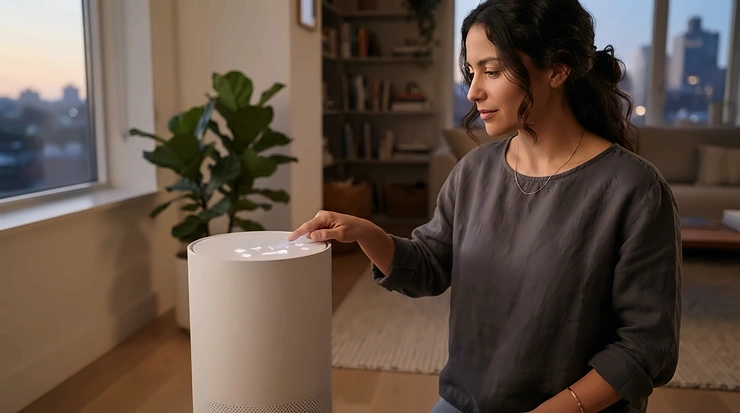
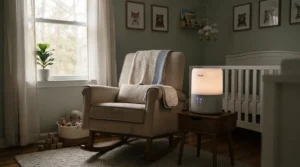
It’s 2:47 a.m. The baby has finally gone down, you’re tiptoeing out like a bomb-disposal tech, and then the air purifier clicks, whirs, and throws a blue glow across the ceiling. Forty minutes of rocking, gone. That’s the exact problem a quiet air purifier for light sleepers and nurseries is supposed to solve.
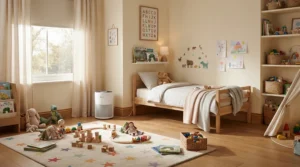
The stakes are real. The World Health Organization recommends less than 30 dB(A) in bedrooms for good-quality sleep, and it notes that children are more exposed to night noise because they spend more time in bed. Plenty of purifiers can hit that mark on their lowest setting. Plenty of others only look like they can on a spec sheet.
A quick note on method. This guide is built from published specs, AHAM-verified performance data, and aggregated review themes. I haven’t hauled seven machines into a nursery, and I won’t pretend otherwise. Where a number is a manufacturer claim, I say so. That matters, because decibel figures are mostly self-reported.
Below you’ll find seven real models, a plain-English breakdown of the decibel level on low, and a look at what night mode and a sleep timer really do. There’s also a section on why an air purifier with dim display for baby nursery duty can matter as much as the sound itself, plus setup guides and honest trade-offs.
Quick Comparison: Quiet Air Purifier for Light Sleepers and Nurseries at a Glance
| Model | Lowest-Speed Noise | Room Class | Price Range* | Best For |
|---|---|---|---|---|
| Levoit Core 300S | ~24 dB (claimed) | ~222 sq ft at 4.8 ACH (AHAM) | $100-$150 | Best all-rounder |
| Blueair Blue Pure 211i Max | ~23 dB (claimed) | ~465 sq ft (AHAM-listed) | $250-$350 | Big rooms, strong airflow |
| Coway Airmega AP-1512HH Mighty | ~24 dB (roundup-reported) | ~360 sq ft class | $180-$250 | No-app simplicity |
| Winix 5510 | ~23.5 dB (listing) | ~392 sq ft (listing) | $150-$250 | Smart auto mode |
| Rabbit Air BioGS 2.0 | ~22 dBA (roundup-reported) | Medium rooms | $500-$650 | Premium hush and design |
| Blueair Blue Pure 511i Max | ~30.8 dBA (RTINGS-measured) | ~149 sq ft at lowest speed | $150-$220 | Compact small rooms |
| Momcozy Nursery Air Purifier | ~21 dB (manufacturer) | ~250 sq ft (manufacturer) | $90-$160 | Budget nursery pick |
*Price ranges at the time of research; prices vary, so check current price.
Look at the noise column and notice how many numbers carry a label like “claimed” or “listing.” Only one entry, the Blueair Blue Pure 511i Max, comes from an independent lab-style measurement, and it’s the loudest of the group at its lowest speed. For a nursery, the Levoit Core 300S and Winix 5510 give the best blend of verified airflow and low-speed quiet. The Momcozy Nursery Air Purifier is the budget wildcard: very low claimed noise, but coverage and noise are both manufacturer figures.
💬 Just one click — help others make better buying decisions too!😊
Top 7 Quiet Air Purifier for Light Sleepers and Nurseries: Expert Analysis
Each pick below gets the same treatment: what the spec means in practice, who it suits, what reviewers keep saying, and an honest trade-off. None of this is hands-on testing. It’s analysis of real specs and aggregated review sentiment.
1. Levoit Core 300S — best all-rounder with a display that goes fully dark
The Levoit Core 300S earns the top slot because its night mode behaves like one: the display can be switched off entirely, so there’s no glow for a baby to notice at 3 a.m. Levoit lists roughly 24 dB in sleep mode and an AHAM VERIFIDE smoke CADR of 143 CFM (dust 153, pollen 167). In practice, that means a rated ~222-square-foot room gets a full air change about 4.8 times an hour at top speed, and a space up to ~1,073 square feet once an hour.
Based on the spec comparison, this is the sweet spot for a typical bedroom-sized nursery. You’re getting independently verified airflow rather than a marketing number. The catch is the usual one: the quiet figure belongs to the lowest speed, and the verified CADR belongs to the highest. You’ll live between the two.
Reviewers consistently describe sleep mode as easy to forget about, and the app and scheduling features come up as a parent-friendly bonus. Common complaints are audible airflow on higher speeds and the ongoing cost of proprietary filters; reviews suggest off-brand filters can hurt performance.
Pros:
- ✅ Display switches fully off at night
- ✅ AHAM-verified CADR, not just claims
- ✅ App scheduling plus timer options
Cons:
- ❌ Audible airflow on higher fan speeds
- ❌ Proprietary filters add ongoing cost
Typically around $100-$150 at the time of research; strong value for verified performance.
2. Blueair Blue Pure 211i Max — quiet and powerful enough for bigger nurseries
The Blueair Blue Pure 211i Max flips the usual trade-off. Roundups cite a minimum of about 23 dB and roughly 2.2 watts in sleep mode, while retail spec listings show a rated room size around 465 square feet. High airflow is the hidden key to a good nursery purifier: a unit with plenty of headroom can clean a 200-square-foot room while loafing on its lowest speed.
That makes the Blueair Blue Pure 211i Max a smart choice if your “nursery” is really a big bedroom, or if you live near traffic or wildfire-prone areas where you want real filtering power without a jet-engine soundtrack. Blueair’s own night mode guidance describes dimming indicator lights and cutting display brightness, which is the behavior you want. Coverage and noise are both manufacturer-reported, though, and listings differ on rated area, so treat the exact square footage as approximate.
Reviewers praise the low-speed hush and the room-filling performance. Recurring gripes center on price and the upkeep of the fabric pre-filter, with replacement filters needed roughly twice a year.
Pros:
- ✅ Strong airflow without needing high speeds
- ✅ Very low claimed minimum noise
- ✅ App and voice assistant control
Cons:
- ❌ Priciest of the mainstream picks
- ❌ Filter replacements every six months or so
Roughly $250-$350 at the time of research; best value if your room is large.
3. Coway Airmega AP-1512HH Mighty — the no-app classic with an Eco mode
The Coway Airmega AP-1512HH Mighty is the “set it and forget it” pick. One roundup reports a 24.4 dB floor at the lowest speed, and the second speed is often described as a gentle, steady whoosh, useful if your baby sleeps better with soft background sound. It also has a lights-off option, timer settings, and an Eco mode that pauses the fan after a stretch of clean air.
What does that mean at 3 a.m.? Fewer decisions. There’s no app to sign into, no Wi-Fi hiccup, and indicator lights you can darken with a button. A recent RTINGS-based roundup also recommends the newer Mighty2 for roughly 257 square feet at its lowest setting, which suggests the line keeps its quiet-speed performance.
Reviewers like the straightforward controls and filter-change reminders. A frequent complaint is that auto mode can ramp the fan up and down, which a light sleeper might notice, so at night a fixed low speed is the safer choice.
Pros:
- ✅ Lights-off option and simple controls
- ✅ Gentle second speed doubles as soft white noise
- ✅ Clear filter-change indicators
Cons:
- ❌ No app or remote scheduling
- ❌ Auto mode fan changes can be noticeable
Typically around $180-$250 at the time of research; great for parents who want fewer gadgets.
4. Winix 5510 — smart auto mode at a claimed 23.5 dB
The Winix 5510 brings listing-reported figures of 23.5 dB on low, AHAM-verified coverage of about 392 square feet, True HEPA filtration, and an app with auto mode. A higher verified coverage number than the Levoit Core 300S means the Winix 5510 can handle a larger nursery or a combined nursery and play space while staying near its quietest setting.
Here’s what the spec sheet won’t tell you: auto mode is convenient in daytime but it’s a gamble overnight. A fan that responds to every puff of cooking odor can step up in the small hours. Consider locking the unit to its sleep setting at night and letting auto mode run during the day. If your model has an ionizing option, I’d leave it off for the nursery; plain filtration is the conservative choice.
Review themes are positive on noise and coverage, though the sample behind this specific model is smaller than for the Levoit Core 300S, so treat sentiment as directional.
Pros:
- ✅ Verified-style coverage for larger rooms
- ✅ Low claimed noise on the lowest speed
- ✅ App control and auto mode
Cons:
- ❌ Larger footprint than compact towers
- ❌ Optional ionizer adds another setting to manage
Around $150-$250 at the time of research; solid mid-range value.
5. Rabbit Air BioGS 2.0 — premium hush that doesn’t look like a machine
The Rabbit Air BioGS 2.0 is the whisper-quiet air purifier for sleeping if budget isn’t your main constraint. One roundup cites a lowest-speed figure around 22 dBA, and the slim, furniture-friendly design means it won’t dominate a small nursery. I could only find that noise figure in a roundup, so confirm it on Rabbit Air’s spec page before you buy.
The real value here is that quiet holds up beyond the lowest speed. Reviewers describe it as unobtrusive even when working harder, which matters because a purifier that is silent on low but roars on medium forces you to live on low. If the machine will sit in a room you pass through daily, aesthetics also count more than you’d expect.
Owner sentiment centers on low noise and appearance. The consistent downsides are the price tag and the cost of replacement filters.
Pros:
- ✅ Very low claimed noise across speeds
- ✅ Slim design blends into a nursery
- ✅ Multi-stage filtration
Cons:
- ❌ Highest purchase price in this list
- ❌ Replacement filters are a real ongoing cost
Roughly $500-$650 at the time of research; worth it only if quiet and design are priorities.
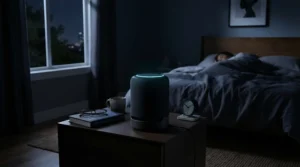
6. Blueair Blue Pure 511i Max — compact, but a lesson in claimed versus measured noise
The Blueair Blue Pure 511i Max is small, app-enabled, and adjusts automatically to air quality. It’s also the most instructive entry here. One listing advertises quiet operation as low as 19 dB, while an RTINGS-based roundup reports a measured 30.8 dBA at its minimum speed, with a 149-square-foot recommendation at that setting. At full speed, that same roundup measures 53.9 dBA for roughly 234 square feet.
Translation: the “quietest” figure on a box and the number from an independent bench test can be 10 dB or more apart. A reading around 30 dBA is still reasonable for a small room and sits right at the WHO guideline, but it isn’t “can’t hear it at all.” For a compact nursery or a dorm-sized bedroom, the Blueair Blue Pure 511i Max is a decent fit; for a light sleeper, I’d rather see lower measured numbers.
Reviewers like the compact footprint and app control. The common compromise is limited coverage at the quiet speed.
Pros:
- ✅ Compact footprint for small rooms
- ✅ App control with auto adjustment
- ✅ Independently measured noise data exists
Cons:
- ❌ Measured lowest speed sits near 30 dBA
- ❌ Small coverage at its quietest setting
Around $150-$220 at the time of research; best for small rooms where space matters.
7. Momcozy Nursery Air Purifier — budget pick with a dimmable night light
The Momcozy Nursery Air Purifier is built around the nursery use case. The manufacturer lists a 21 dB sleep mode, a four-filter system with H13 HEPA and carbon, a real-time PM2.5 monitor with a three-color status display, a dimmable night light, and a roughly 250-square-foot coverage claim. It does not include a humidifier.
As an air purifier with dim display for baby nursery duty, the useful part is that the night light and display can be turned down or off. For a 3 a.m. diaper change, a low, dimmable glow is more gentle than flipping on the overhead light. The caution: every number here is a manufacturer figure, and I couldn’t find AHAM verification, so I wouldn’t size a large room on the coverage claim.
Retail ratings are glowing; one nursery registry page shows a 5.0 average from 83 ratings. That’s a small sample, so use it as encouragement rather than proof.
Pros:
- ✅ Dimmable night light and display
- ✅ Very low claimed sleep-mode noise
- ✅ Budget-friendly nursery features
Cons:
- ❌ Noise and coverage are unverified claims
- ❌ Best for small rooms only
Typically $90-$160 at the time of research; good value if the room is small.
Spec and Value Snapshot
| Model | Night Mode / Dim Display | Biggest Trade-Off |
|---|---|---|
| Levoit Core 300S | Display can be turned off | Proprietary filters |
| Blueair Blue Pure 211i Max | Night mode dims lights | Higher price |
| Coway Airmega AP-1512HH Mighty | Lights-off option | No app; auto mode ramps |
| Winix 5510 | Sleep setting dims display | Auto mode can step up at night |
| Rabbit Air BioGS 2.0 | Sleep mode dims lights | Cost of unit and filters |
| Blueair Blue Pure 511i Max | App and night controls | Measured ~30.8 dBA on low |
| Momcozy Nursery Air Purifier | Dimmable night light | Unverified performance claims |
Looking at the comparison above, the Levoit Core 300S delivers the best verified value under $200, but if your nursery is large, the Blueair Blue Pure 211i Max justifies the extra spend with its airflow headroom. Budget buyers should note the Momcozy Nursery Air Purifier trades independent verification for a low price. And the Blueair Blue Pure 511i Max is a reminder to check measured noise, not just claimed noise.
✨ Ready to Find Your Fit?
🔍 Take your nursery’s night routine to the next level with these carefully selected purifiers. Click on any highlighted product name to check current pricing and availability. A calmer room, a quieter night, and fewer 3 a.m. surprises are worth a few minutes of comparison!
Setting Up Your Quiet Air Purifier for Light Sleepers and Nurseries: The First 30 Days
Most noise complaints come from placement and habits, not the machine. A few moves make a bigger difference than a model swap.
Place it wisely. Sound falls off with distance, and the sweet spot is usually a few feet from the crib, not on the nightstand beside it. Keep intakes clear of walls, curtains, and furniture, keep the cord out of reach, and follow the manual’s clearance guidance.
Pre-clean, then go quiet. Run the unit on a higher speed for an hour or two before bedtime or during the day, when noise doesn’t matter. Then drop to night mode or the lowest speed when the room is occupied. That gives you the cleaning power of a higher setting without making a bedtime soundtrack of it.
Set a routine. Use the app schedule or sleep timer so the unit shifts to its quiet setting at the same time each evening. If you want it running all night, skip the timer; if you want it off after the baby settles, set one.
Avoid first-month mistakes:
- Running the unit on high at bedtime “just in case”
- Leaving the display bright because you never found the button
- Ignoring filter-change reminders
- Skipping the manual’s note about sensor placement
Do this and the Levoit Core 300S or Winix 5510 will feel quieter than the numbers suggest, simply because you’ve stopped asking them to work hard at night.
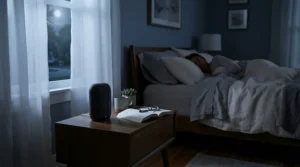
Real-World Scenarios: Matching a Quiet Air Purifier to Your Home
Specs mean little until you attach them to a real room. Here are three profiles built from common situations.
Scenario 1: The compact nursery. A 110-square-foot room, budget-minded parents, unit running nightly. A Levoit Core 300S covers it comfortably and the display can go dark; the Momcozy Nursery Air Purifier is the lower-cost alternative if you accept unverified claims. Either runs on its lowest setting most of the night.
Scenario 2: The light sleeper on a busy street. A 300-square-foot bedroom with traffic noise. Here airflow headroom matters, because city air plus an open-plan layout means you want to stay on low while still moving plenty of air. The Blueair Blue Pure 211i Max or Winix 5510 fits, and a steady purifier hum may even blend into the street baseline.
Scenario 3: One-bedroom, shared room. Parents and a baby in the same ~150-square-foot room. Quiet and darkness both matter, since you’re sleeping there too. A Coway Airmega AP-1512HH Mighty with its lights-off option and no app notifications keeps things simple, and the Blueair Blue Pure 511i Max works if space is tight and you accept its measured noise.
In all three, run it daily and match the filter schedule to your use. Seasonal pollen or wildfire smoke may justify a higher-CADR unit like the Blueair Blue Pure 211i Max.
Problem → Solution Guide: Fixing the Most Common Nursery Purifier Annoyances
Problem 1: “It’s quiet, but the room still smells.” The lowest speed may be too gentle for your room size. Run a higher speed during the day, or step up to a larger unit such as the Winix 5510.
Problem 2: “The light keeps waking the baby.” Use the display-off feature on the Levoit Core 300S, the lights-off option on the Coway Airmega AP-1512HH Mighty, or turn down the Momcozy Nursery Air Purifier‘s night light. If your unit can’t go fully dark, a small piece of removable tape over an indicator is a low-tech fix.
Problem 3: “Auto mode keeps changing speeds.” Switch to a fixed low speed or night mode overnight. Auto mode is built to respond, and a response at 2 a.m. is exactly what you don’t want.
Problem 4: “There’s a hum or rattle.” Put it on a hard, flat surface, away from the wall, and make sure the filter is seated. Vibration through a wobbly shelf can add more noise than the fan.
Problem 5: “Filters cost too much.” Log your replacement date when you install the filter, buy ahead, and treat the cost as part of ownership, a topic covered below.
What Is a Quiet Air Purifier for Light Sleepers and Nurseries?
A quiet air purifier for light sleepers and nurseries is a portable HEPA air cleaner that holds its lowest-speed noise near or below roughly 30 dB, keeps its lights dim or off at night, and still delivers verified airflow for the room’s size. In short: clean air without the sleep-wrecking hum or glow.
Portable air cleaners filter the air in a single room, and the EPA’s guide to air cleaners in the home is a good neutral starting point. The EPA does not certify or recommend specific brands, so “quiet” and “nursery-safe” are labels you have to verify yourself.
Three terms matter. HEPA means a filter captures at least 99.97% of particles at 0.3 microns. CADR (Clean Air Delivery Rate) measures how fast a purifier cleans smoke, dust, and pollen. Night mode usually means the lowest fan speed plus dimmed lights. Understand those three and most marketing copy becomes easy to decode.
How to Choose a Quiet Air Purifier for Light Sleepers and Nurseries
- Check noise on the lowest setting, then the second-lowest. Under 30 dB is ideal, in line with the WHO guideline. The second speed is where many units actually spend their time.
- Match smoke CADR to your room. A common rule is a smoke CADR of at least two-thirds of the room’s square footage. AHAM also calculates suggested room size as CADR multiplied by 1.55 at 4.8 air changes per hour.
- Prefer AHAM-verified performance. Independent verification beats a large coverage claim on a listing.
- Insist on a real dark mode. A display that turns off completely, or a dimmed night mode, is worth more than a pretty light show.
- Look for scheduling or a sleep timer. Whether you want all-night operation or a timed shutdown, you need control over it.
- Skip ozone and ionizer gimmicks. For a nursery, plain HEPA filtration is the conservative choice, and look for ozone-free certification.
The most overlooked trade-off is airflow versus noise. A larger, more powerful unit can often run quieter at the same real-world cleaning rate than a small one working flat out.
Decibel Level on Low: What the Numbers Really Mean
Decibels sit on a logarithmic scale, so a small-looking number gap hides a large difference. A rough rule is that each 10 dB step sounds about twice as loud. That’s why the gap between a claimed 19 dB and a measured 30.8 dBA on the Blueair Blue Pure 511i Max is much bigger than it looks.
Two more caveats. First, decibel figures are largely self-reported: as NBC News notes in its quiet purifier guide, no official outside body verifies decibel claims. Second, it’s common for makers to publish only the lowest-speed number, which says nothing about how a unit sounds on medium.
So how should you read the decibel level on low? Treat it as a best case, not an average. A listing of 23-24 dB, like the Levoit Core 300S or Blueair Blue Pure 211i Max, is promising, but confirm with owner reviews and, where available, independent measurements. Also remember that your bedroom isn’t silent. Typical homes have a baseline of 35-45 dB, so a steady purifier hum on its lowest setting tends to blend into the background rather than stand out.
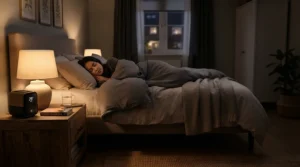
Air Purifier With Dim Display for Baby Nursery: Why Light Matters as Much as Sound
Parents obsess over decibels and forget the glowing ring on the front. In a dark room, even a small indicator can catch attention, and general sleep guidance favors a dark sleep environment (ask your pediatrician if you have specific concerns). An air purifier with dim display for baby nursery use removes one more variable.
There are four styles of “dark”:
- Fully off display: The Levoit Core 300S lets you switch the panel off entirely.
- Dimmed night mode: The Blueair Blue Pure 211i Max reduces indicator brightness rather than killing it.
- Lights-off button: The Coway Airmega AP-1512HH Mighty has a dedicated option for this.
- Dimmable night light: The Momcozy Nursery Air Purifier adds a soft glow you can turn down or off.
Don’t ignore the little things. Touch buttons that beep, color-coded air quality rings that stay bright, and status LEDs that can’t be disabled can all undermine an otherwise quiet unit. Before buying, check whether the dim setting persists after power cycles and whether the control sounds can be silenced.
Night Mode and Sleep Timer: Features That Actually Matter (And Those That Don’t)
Night mode and a sleep timer are the two features worth paying attention to, but they’re often misunderstood.
Night mode generally means the lowest fan speed with dimmed lights, and sometimes auto-sensing. It is not the same as auto mode. Auto mode reacts to air quality; night mode stays calm. Check which one your unit calls what.
A sleep timer shuts the unit off after a set period. Some listings cite options like 2, 4, 6, or 8 hours, but confirm the exact settings on your model. The catch: a timer that cuts power at 2 a.m. defeats the purpose during smoky or high-pollen seasons. For many nurseries, scheduling via an app or simply leaving the unit on low is better than a hard shutoff.
What doesn’t matter much: aroma trays, UV claims, ionizers, and fancy air-quality color shows. Nursery-branded combos like the Frida Baby 3-in-1 add a sound machine and night light, which can be convenient, though I haven’t verified their airflow performance. If all you need is clean, quiet air, don’t pay for extras you’ll switch off.
Whisper Quiet Air Purifier for Sleeping vs. a Box Fan or White Noise Machine
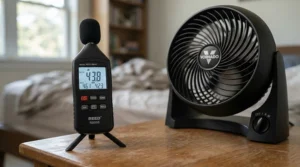
A whisper quiet air purifier for sleeping and a box fan sound similar from across the room, but they solve different problems. A fan moves air; a purifier cleans it. Low-speed fans commonly land around 35-50 dB, according to fan noise comparisons, while the purifiers in this guide claim roughly 20-30 dB on their lowest setting.
| Option | Typical Night Noise | Air Cleaning | Best For |
|---|---|---|---|
| Whisper quiet HEPA purifier (low) | ~20-30 dB (claimed) | Filters fine particles; carbon helps odors | Allergies, dander, smoke |
| Box fan (low) | ~35-50 dB | None | Cooling and masking noise |
| Cracked window | Outdoor noise varies | None; may let pollen in | Free ventilation |
| Central HVAC filter | Blower noise when running | Whole-home, depends on filter | Baseline house air |
Looking at the table, a purifier is the only option that both cleans and stays near the WHO’s 30 dB(A) bedroom guideline. If your baby needs a louder white-noise cue, pair a purifier like the Coway Airmega AP-1512HH Mighty (whose second speed reviewers often describe as gentle white noise) with a dedicated sound machine rather than cranking a fan. Note that the best noise-masking effect depends on a real background noise problem; if your room is already very quiet, adding sound can be a net negative.
Long-Term Cost & Maintenance: What a Quiet Purifier Really Costs
Purchase price is only the opening bid. Filters are the long game. Replacement intervals are commonly around six to twelve months depending on brand and use, and replacement filters often cost a meaningful fraction of the machine’s price. Over three years, filter spend can rival the unit’s cost, so check your model’s filter price before you commit.
Electricity is the easy part. At roughly 2-3 watts on a low setting, as one roundup cites for the Blueair Blue Pure 211i Max, running a purifier around the clock costs only a few dollars a year at typical U.S. rates. Higher speeds use more power, but you won’t be there much.
Do the cost-per-night math: a unit costing $150, run nightly for three years, works out to roughly 14 cents a night before filters. Add filters and you’re likely still well under a dollar a night, a tiny price for quieter, cleaner air.
To protect your investment, verify performance claims in the AHAM Directory of Certified Room Air Cleaners before buying, since AHAM says listed models have independently verified smoke, dust, and pollen CADR. Then track your filter dates, and clean pre-filters on schedule so the fan doesn’t strain.
FAQ
❓ What decibel level is too loud for a quiet air purifier in a nursery?
❓ Is night mode safe to run all night in a baby's room?
❓ Do I really need a sleep timer on a nursery air purifier?
❓ How far should a purifier sit from the crib?
❓ Can an air purifier with dim display for baby nursery use go fully dark?
Conclusion: Choosing Your Quiet Air Purifier for Light Sleepers and Nurseries
The best quiet air purifier for light sleepers and nurseries isn’t the one with the lowest number on the box. It’s the one whose low-speed noise, dark mode, and verified airflow fit your room. For most families, the Levoit Core 300S is the best balance of price, verified performance, and a truly dark display. If your room is larger or you want extra headroom, the Blueair Blue Pure 211i Max and Winix 5510 are the stronger fits. The Coway Airmega AP-1512HH Mighty wins for no-fuss simplicity, the Rabbit Air BioGS 2.0 for premium quiet, and the Momcozy Nursery Air Purifier for a budget-friendly nursery start, with the caveat that its numbers are unverified.
Whichever you choose, remember the rules of the road: judge the decibel level on low as a best case, run a pre-clean cycle earlier in the day, use night mode and a sleep timer deliberately, and keep the display dark. Do that, and your next 3 a.m. should be about the baby, not the machine.
Recommended for You
- [Add your blog post link 1]
- [Add your blog post link 2]
- [Add your blog post link 3]
Disclaimer: This article contains affiliate links. As an Amazon Associate, I earn from qualifying purchases. If you purchase products through these links, we may earn a small commission at no additional cost to you.
✨ Found this helpful? Share it with your friends! 💬🤗
